
Ethical hacking is the practice of testing computers, applications, networks and security controls with proper authorization to identify weaknesses before malicious attackers can exploit them.
Learning ethical hacking requires more than watching videos or memorizing commands.
A strong learning program normally combines:
- Networking fundamentals
- Linux and Windows knowledge
- Web technologies
- Security concepts
- Hands-on laboratories
- Vulnerability analysis
- Penetration-testing methodology
- Report writing
- Continuous practice
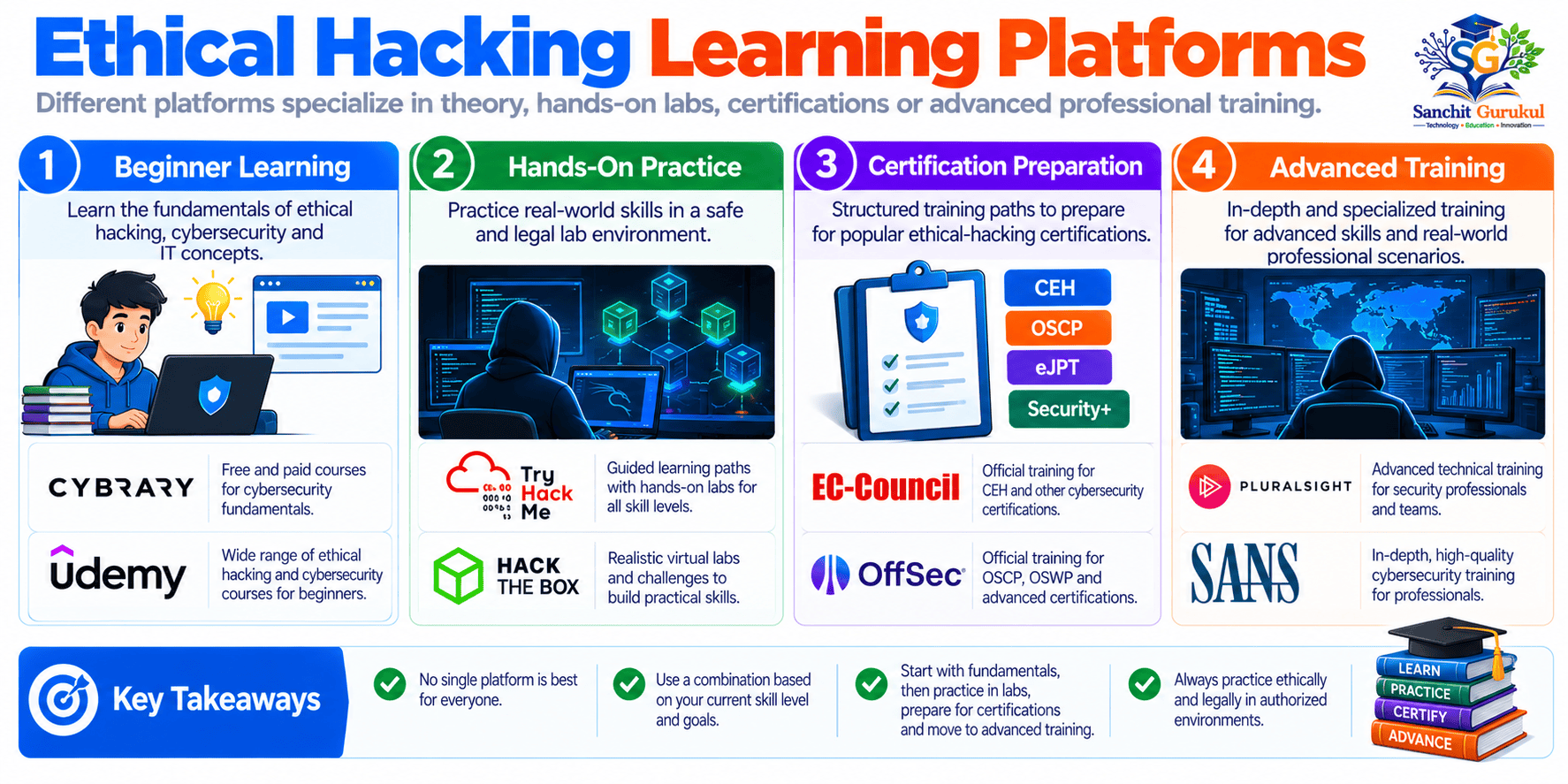
Fortunately, several online platforms provide structured cybersecurity training and safe environments where learners can practice.
Popular options include:
- Cybrary
- Udemy
- EC-Council
- TryHackMe
- Hack The Box
- OffSec
- Pluralsight
- SANS Institute
Each platform serves a different purpose.
Some are ideal for complete beginners.
Others focus heavily on practical labs.
Some are designed for professional certification preparation.
And several target experienced penetration testers and security professionals.
How to Choose an Ethical Hacking Platform
Before choosing a training platform, determine what you actually want to learn.
A beginner has very different requirements from an experienced penetration tester preparing for an advanced certification.
1. Your Current Skill Level
If you are completely new, start with:
- Networking
- TCP/IP
- Linux
- Windows
- Web fundamentals
- Security fundamentals
Jumping directly into advanced exploitation labs can make learning unnecessarily difficult.
2. Theory vs Hands-On Learning
Some platforms emphasize:
- Video courses
- Reading
- Instructor explanations
Others focus primarily on:
- Virtual machines
- Challenges
- Attack simulations
- CTF exercises
- Realistic lab environments
Ethical hacking requires both.
3. Certification Goals
If your objective is a particular certification, training aligned with that certification may be more useful than a general hacking course.
Examples include:
- CEH
- OSCP
- GIAC certifications
- Security+
- Vendor-specific cybersecurity certifications
4. Budget
Training costs vary significantly.
Options range from:
- Free learning resources
- Low-cost individual courses
- Monthly subscriptions
- Premium professional training
- High-cost instructor-led programs
Do not assume that the most expensive option is automatically the best place to begin.
5. Practical Labs
For penetration testing and ethical hacking, hands-on practice is essential.
Look for platforms offering:
- Isolated virtual machines
- Guided labs
- Web application exercises
- Network attack simulations
- CTF challenges
- Enterprise-style environments
Best Websites to Learn Ethical Hacking
The following platforms serve different types of learners.
There is no universal winner.
The best option depends on:
Skill Level + Learning Style + Career Goal + Budget
1. TryHackMe
Best For: Beginners and hands-on learners
TryHackMe focuses strongly on interactive cybersecurity learning.
Instead of only watching lectures, learners can work through guided environments and security challenges.
Typical learning areas include:
- Networking
- Linux
- Windows
- Web security
- Enumeration
- Privilege escalation
- Penetration testing
- Defensive security
- CTF challenges
One of the main advantages for beginners is:
Guided learning
A learner can study a concept and then immediately interact with a practical environment.
Why TryHackMe Is Useful
Good for:
- Beginners
- Step-by-step learning
- Practical exercises
- Guided cybersecurity paths
- Building confidence before harder labs
Main Strength:
Combines explanation and hands-on practice.
A beginner could use TryHackMe to progress through:
Networking Basics
↓
Linux Fundamentals
↓
Web Fundamentals
↓
Security Fundamentals
↓
Guided Labs
↓
CTF Challenges2. Hack The Box
Best For: Intermediate to advanced practical learning
Hack The Box is strongly associated with practical cybersecurity training and challenging lab environments.
Learners can work with:
- Virtual machines
- Web challenges
- CTF exercises
- Penetration-testing labs
- Enterprise-style environments
- Structured Academy content
Compared with beginner-focused guided platforms, some Hack The Box environments can require more independent problem solving.
That makes it especially useful after the learner understands fundamental concepts.
Why Hack The Box Is Useful
Good for:
- Practical penetration testing
- Intermediate learners
- Advanced learners
- Independent problem solving
- CTF practice
- Realistic environments
Main Strength:
Deep hands-on practice.
3. Cybrary
Best For: Structured cybersecurity learning
Cybrary provides cybersecurity-focused courses covering multiple security areas.
Depending on the available learning path, topics can include:
- Security fundamentals
- Ethical hacking
- Penetration testing
- Network security
- Cloud security
- Security operations
- Certification preparation
Its broader cybersecurity focus can make it useful for learners who want to study more than offensive security.
Why Cybrary Is Useful
Good for:
- Cybersecurity beginners
- Structured learning
- Broad security knowledge
- Career-focused study
- Certification preparation
Main Strength:
Broad cybersecurity curriculum.
A learner interested in cybersecurity as a career may benefit from studying both:
Offensive security
and:
Defensive security
rather than learning exploitation techniques alone.
4. Udemy
Best For: Flexible and budget-conscious learners
Udemy provides a large marketplace of technology courses.
Ethical hacking topics can include:
- Cybersecurity fundamentals
- Networking
- Linux
- Python
- Web application security
- Penetration testing
- Wireshark
- Malware analysis
- Cloud security
The main advantage is:
Choice
Learners can select individual courses based on a particular skill gap.
For example:
Need Linux?
→
Take a Linux fundamentals course

Need Networking?
→
Study TCP/IP and network fundamentals

Need Web Security?
→
Choose a web application security course

Need Python?
→
Study Python for automation
However, course quality can vary because content is created by different instructors.
5. EC-Council
Best For: Learners interested in CEH and EC-Council certification paths
EC-Council is widely known for:
Certified Ethical Hacker — CEH
Its official training ecosystem is primarily useful for learners who specifically want training aligned with EC-Council certification objectives.
Training can cover areas such as:
- Ethical hacking methodology
- Reconnaissance
- Network security
- Web security
- Vulnerability analysis
- Attack techniques
- Security countermeasures
Why EC-Council Training Is Useful
Good for:
- CEH candidates
- Certification-focused learning
- Structured professional training
- Learners requiring official courseware
Main Strength:
Training aligned with EC-Council certification programs.
6. OffSec
Best For: Serious penetration-testing learners
OffSec is strongly associated with practical offensive-security training.
It is particularly well known for:
OSCP
and its hands-on approach to penetration-testing education.
Offensive-security learning requires learners to:
- Investigate systems
- Enumerate services
- Understand vulnerabilities
- Solve technical problems
- Work independently
- Document results
This style of training is generally better suited to learners who already understand:
- Networking
- Linux
- Windows
- Basic scripting
- Web technologies
- Security fundamentals
Why OffSec Is Useful
Good for:
- Penetration-testing careers
- Serious practical learners
- Certification-focused professionals
- Independent problem solving
- Advanced offensive-security development
Main Strength:
Practical penetration-testing methodology.
7. Pluralsight
Best For: Structured technology and cybersecurity video learning
Pluralsight offers broader technology education that includes cybersecurity.
Its strength is useful when ethical-hacking learners also need to improve supporting skills such as:
- Networking
- Cloud
- Programming
- Linux
- Windows
- DevOps
- Security architecture
This matters because ethical hacking requires knowledge across many technologies.
Why Pluralsight Is Useful
Good for:
- Structured video learning
- Technology fundamentals
- Intermediate learners
- Certification study
- Filling specific skill gaps
Main Strength:
Large technology curriculum beyond security alone.
For example, someone struggling with cloud security may first need to understand:
How cloud infrastructure works
before trying to identify:
cloud security weaknesses.
8. SANS Institute
Best For: Experienced cybersecurity professionals and advanced training
SANS is known for professional cybersecurity training across many specialized areas.
Training areas can include:
- Penetration testing
- Incident response
- Digital forensics
- Cloud security
- Security operations
- Malware analysis
- Application security
- Network security
SANS training is commonly associated with:
GIAC certifications
and professional-level cybersecurity education.
Why SANS Is Useful
Good for:
- Experienced professionals
- Advanced cybersecurity specialization
- Professional training
- GIAC certification preparation
- Organizations investing in workforce development
Main Strength:
Deep specialist cybersecurity training.
The primary limitation for many individual learners is:
Cost
For beginners paying personally, lower-cost training and hands-on labs may provide a more practical starting point.
Which Platform Should You Choose?
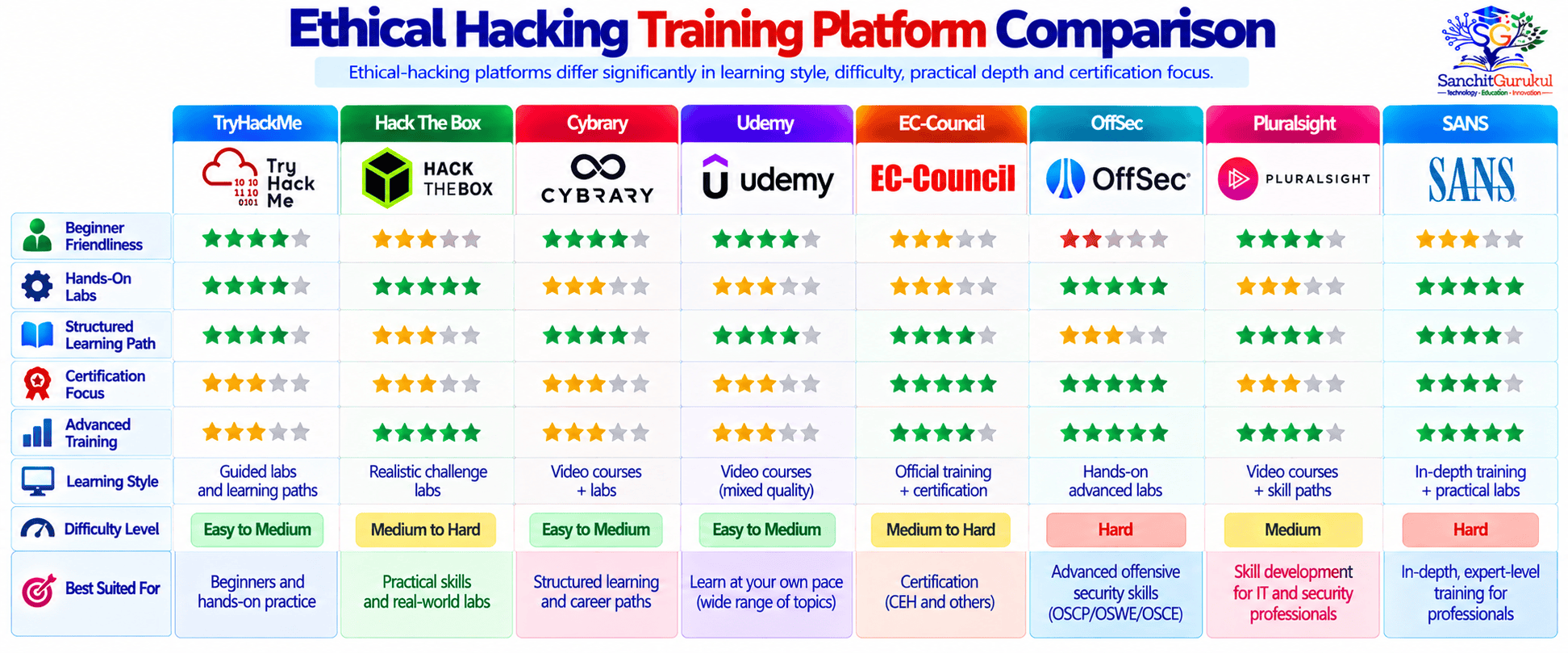
A simple comparison can make the decision easier.
| Platform | Best For | Hands-On Focus | Typical Level |
|---|---|---|---|
| TryHackMe | Guided practical learning | High | Beginner → Advanced |
| Hack The Box | Practical penetration testing | Very High | Intermediate → Advanced |
| Cybrary | Structured cybersecurity learning | Medium | Beginner → Professional |
| Udemy | Affordable individual courses | Varies | Beginner → Advanced |
| EC-Council | CEH-focused certification training | Medium–High | Beginner → Professional |
| OffSec | Professional offensive security | Very High | Intermediate → Advanced |
| Pluralsight | Technology and security learning | Low–Medium | Beginner → Advanced |
| SANS | Professional specialist training | High | Intermediate → Advanced |
Recommended Ethical Hacking Learning Path
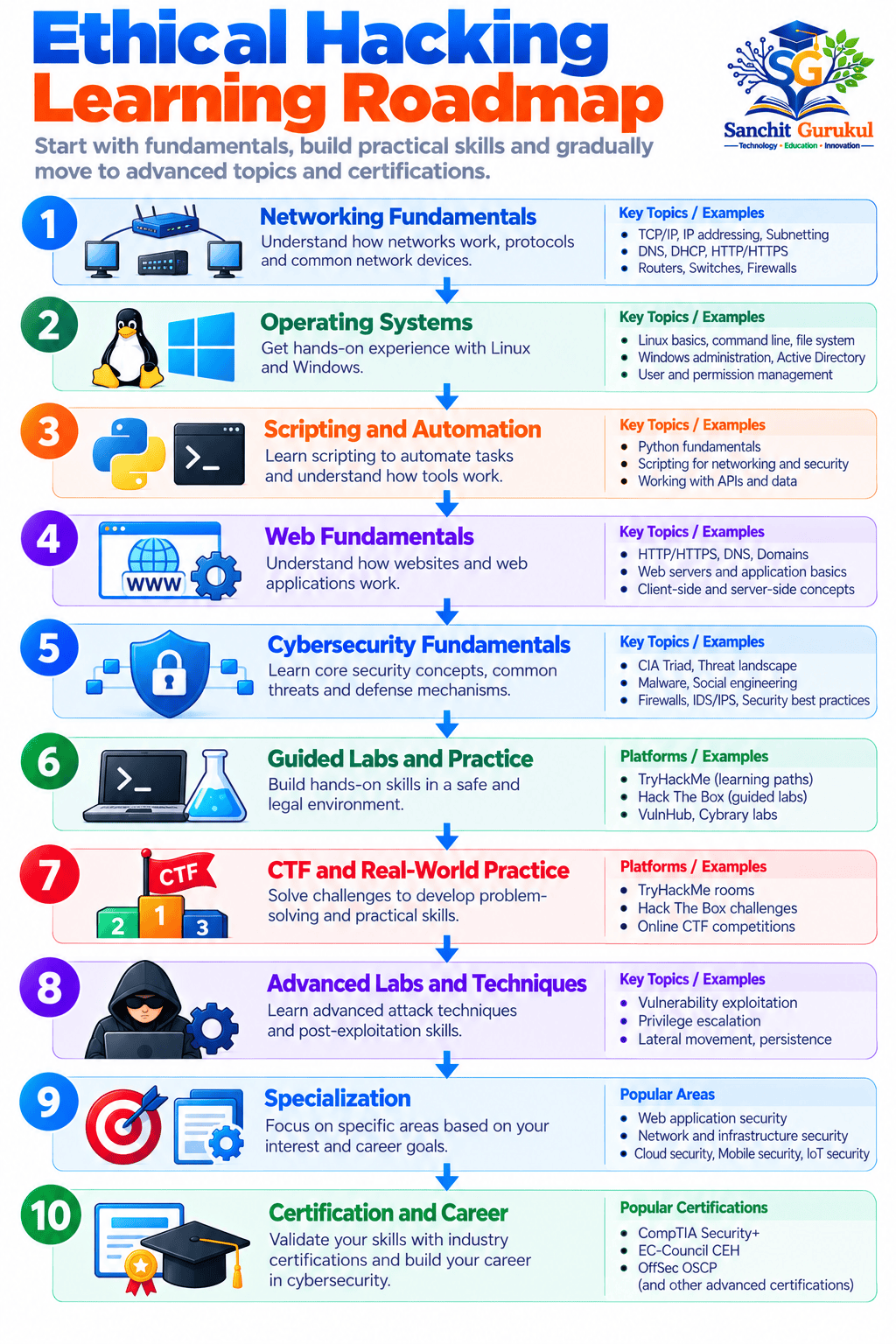
Instead of randomly completing courses, follow a structured progression.
Stage 1 — Networking Fundamentals
Learn:
- OSI model
- TCP/IP
- IPv4
- IPv6
- Subnetting
- ARP
- DNS
- DHCP
- TCP
- UDP
- Routing
- NAT
- Firewalls
- HTTP and HTTPS
Stage 2 — Operating Systems
Learn basic Linux administration:
pwd
ls
cd
cat
grep
find
ip
ss
ps
chmod
sudo
Also understand Windows concepts such as:
- Users
- Groups
- Services
- Processes
- NTFS permissions
- PowerShell
- Active Directory fundamentals
Stage 3 — Scripting
You do not need to become an expert software developer before beginning cybersecurity.
But basic scripting is extremely useful.
Good starting choices include:
- Python
- Bash
- PowerShell
Learn concepts such as:
- Variables
- Loops
- Conditions
- Functions
- Files
- Networking
- APIs
- Automation
Stage 4 — Web Fundamentals
Understand:
- HTTP requests
- HTTP responses
- Headers
- Cookies
- Sessions
- Authentication
- HTML
- JavaScript basics
- APIs
- Databases
Without understanding how a normal web application works, web-security testing becomes much harder.
Stage 5 — Security Fundamentals
Study:
- Vulnerabilities
- CVEs
- Authentication
- Authorization
- Cryptography basics
- Network security
- Endpoint security
- Security logging
- Threat actors
- Malware fundamentals
Stage 6 — Guided Labs
Now begin structured practical environments.
A learner might use:
TryHackMe

or

Other Authorized Training Labs
Focus on understanding each technique rather than racing to finish challenges.
Stage 7 — Independent Practical Labs
After gaining confidence, progress toward:
Hack The Box
↓
CTFs
↓
More Complex Labs
↓
Enterprise-Style Environments
Stage 8 — Specialization
Choose an area.
Examples include:
- Network penetration testing
- Web application security
- Active Directory security
- Cloud security
- Mobile security
- Red teaming
- Vulnerability research
- Malware analysis
Stage 9 — Certification
Select certifications based on your career objective.
Do not collect certifications without developing practical understanding.
How to Practice Ethical Hacking Safely
Never use random Internet systems as your practice environment.
Instead, create controlled environments.
Training Platforms
Use authorized platforms such as:
- TryHackMe
- Hack The Box
- Cyber ranges
- CTF platforms
Personal Lab
You can build your own isolated lab using virtual machines.
Example:
Host Computer

├── Kali Linux VM
├── Windows VM
├── Linux Server VM
└── Vulnerable Training VM

Network:
Isolated Virtual Network
This allows you to:
- Capture packets
- Test firewall rules
- Study services
- Examine logs
- Practice administration
- Learn security concepts
without targeting public systems.
Bug Bounty Programs
Bug bounty programs can provide authorized real-world security research opportunities.
However, always read:
- Scope
- Rules
- Prohibited testing
- Rate limits
- Reporting requirements
before performing any testing.
Key Takeaways
- Ethical hacking should always be performed with authorization.
- There is no single best learning website for every student.
- TryHackMe is particularly useful for guided hands-on learning.
- Hack The Box is strong for deeper practical penetration-testing challenges.
- Cybrary provides broader structured cybersecurity learning.
- Udemy offers flexible individual courses covering many cybersecurity topics.
- EC-Council is relevant for learners following the CEH certification path.
- OffSec focuses strongly on practical offensive-security skills.
- Pluralsight is useful for developing broader supporting technology skills.
- SANS is aimed heavily toward advanced professional cybersecurity education.
- Beginners should first understand:
- Networking
- Linux
- Windows
- Web technologies
- Basic scripting
- Ethical hacking is a practical skill.
Watching videos alone is not enough.
- Practice should take place in:
- Authorized labs
- CTF environments
- Personal labs
- Cyber ranges
- Approved bug bounty programs
- Practical understanding is more valuable than memorizing tools.
- Certifications can support career development, but they should complement real technical skills.
- A strong learning sequence is:
Networking
↓
Operating Systems
↓
Scripting
↓
Web Fundamentals
↓
Security Fundamentals
↓
Guided Labs
↓
Advanced Labs
↓
Specialization
↓
CertificationEthical hacking can lead to careers in:
- Penetration testing
- Vulnerability management
- Application security
- Cloud security
- Red teaming
- Security engineering
- Security consulting
- Incident response
- Threat research
The best learning platform is therefore the one that helps you progress toward your specific goal while building genuine practical understanding.
A beginner should not worry about choosing the most advanced platform immediately.
Start with solid fundamentals, practice regularly in authorized environments, and gradually move toward more complex cybersecurity challenges.
Useful Links and References
SanchitGurukul Resources
Ethical Hacking Learning Platforms
Your feedback matters
Was this post helpful?
Discussion
0 approved comments
No approved comments yet. You can start the discussion below.
Leave a Comment
No login is required. Name and email are used for moderation/security. Your email is never displayed publicly. All comments require administrator approval.
Discover more from SanchitGurukul
Subscribe to get the latest posts sent to your email.