
Networking
Build a strong foundation in addressing, routing, switching and network protocols.
Explore networkingExplore networking, cybersecurity and infrastructure through clear guides, practical tools and hands-on learning.
Go deeper into the technologies that power modern networks and secure connected systems.
Build a strong foundation in addressing, routing, switching and network protocols.
Explore networkingExplore firewalls, VPNs, access controls and practical defensive techniques.
Explore network securityUnderstand proxies, load balancing, TLS and reliable application delivery.
Explore application deliveryWork confidently with Linux, cloud platforms and infrastructure tools.
Explore linux & infrastructureUnderstand threats, improve digital safety and develop defensive skills.
Explore cybersecurityUse Python, shell scripting and reusable examples to solve real problems.
Explore programming & automationDiscover something different from our published guide library.

Check Point MDM - Check Point's Multi-Domain Management provides centralized security policy management across multiple domains, enhancing efficiency and tailored control for large enterprises.
Explore Check Point MDM – Powerful Multi-Domain Security Management Made Easy
Check Point Virtual Systems enable independent firewalls within a single appliance, promoting security, scalability, and cost efficiency for diverse environments.
Explore Check Point Virtual Systems Explained — VSX Architecture, Virtual Firewalls and Configuration
Check Point VSX enables the deployment of multiple independent virtual firewalls on a single appliance, suitable for multi-tenant and large organizational environments.
Explore Check Point VSX Explained: Build Scalable & Secure Virtual Firewalls
LACP enhances network reliability by bundling links into EtherChannels, offering bandwidth, redundancy, and efficient management through various configuration modes.
Explore LACP Explained: Static vs Passive vs Active with Real Lab Examples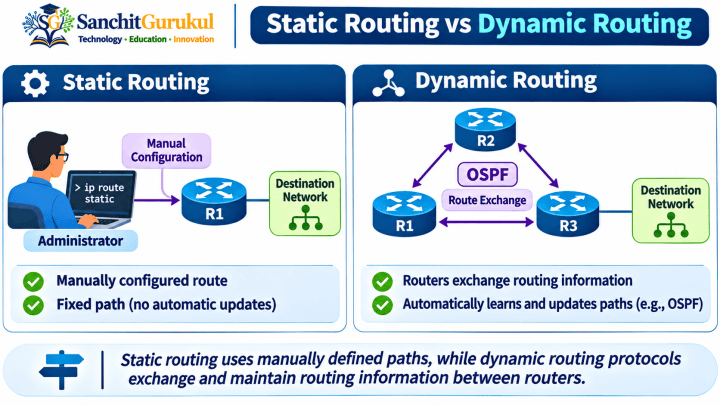
Routers need routing information before they can forward packets toward remote networks. There are two major ways to provide this information: With static routing, an administrator…
Explore Static Routing vs Dynamic Routing — When Should You Use Each?
Prerequisites: Configured Gaia Interfaces, Network Routing, SmartConsole Access and Established SIC Imagine an employee sitting in the office trying to open a business website. The computer…
Explore Check Point Firewall Basic Configuration — Part 2: Security Policies, NAT, Logging and Verification
Prerequisites: Firewall Fundamentals, Throughput, VPN, High Availability and Basic Cisco Security Administration Imagine an enterprise is replacing its older Cisco ASA firewall. The network team identifies…
Explore Cisco Firepower Firewall Hardware Explained — Part 2: 2100, 4100 and 9300 Series Comparison
Prerequisites: Basic Gaia Administration, Backup Concepts and Clish Commands Validation Note: Procedures and commands reviewed against official Check Point Gaia documentation, including R82.20. Not tested on…
Explore Check Point Gaia Scheduled Backups Explained — Part 2: Automated Backups, Retention and Troubleshooting
On-Premises and Cloud Computing: On-premises computing offers control, customization, and potential performance benefits but requires high costs, maintenance, and scalability challenges. Cloud computing provides cost efficiency,…
Explore IT Infrastructure Management: On-Premises and Cloud ExplainedPractical utilities for everyday technical tasks.
Build confidence and discover what to learn next.
Test your understanding, review your results and strengthen your skills.
Start practice ☟Test your understanding, review your results and strengthen your skills.
Start practice ☟Test your understanding, review your results and strengthen your skills.
Start practice ☟Follow the articles in order, from the foundations to practical application.
Understand layers, connections and access controls.
Follow packet flow, configure a firewall, then explore NAT and resilience.
Set up EVE-NG and add Windows and Linux systems.
Learn TCP, deploy HTTP/3 and test your configuration.


