
Full Proxy architecture provides powerful capabilities for application delivery, traffic management, security enforcement, and protocol optimization.
A Full Proxy normally acts as an endpoint on the client-facing connection and establishes a separate connection toward the backend.
This architecture can enable capabilities such as:
- Independent TCP behavior
- Connection buffering
- Backend selection
- Protocol-aware processing
- TLS termination where configured
- Application-layer inspection where supported
- WAF enforcement
- Header or payload modification
- Traffic steering
- Authentication and access policy
However, Full Proxy is not automatically the best architecture for every workload.
The additional connection state, processing, buffering, security inspection, TLS operations, logging, and high-availability requirements can create unnecessary complexity when those capabilities are not required.
The correct design question is therefore not:
“Is Full Proxy better?”
It is:
“Does this application require the capabilities that justify terminating and proxying the connection?”
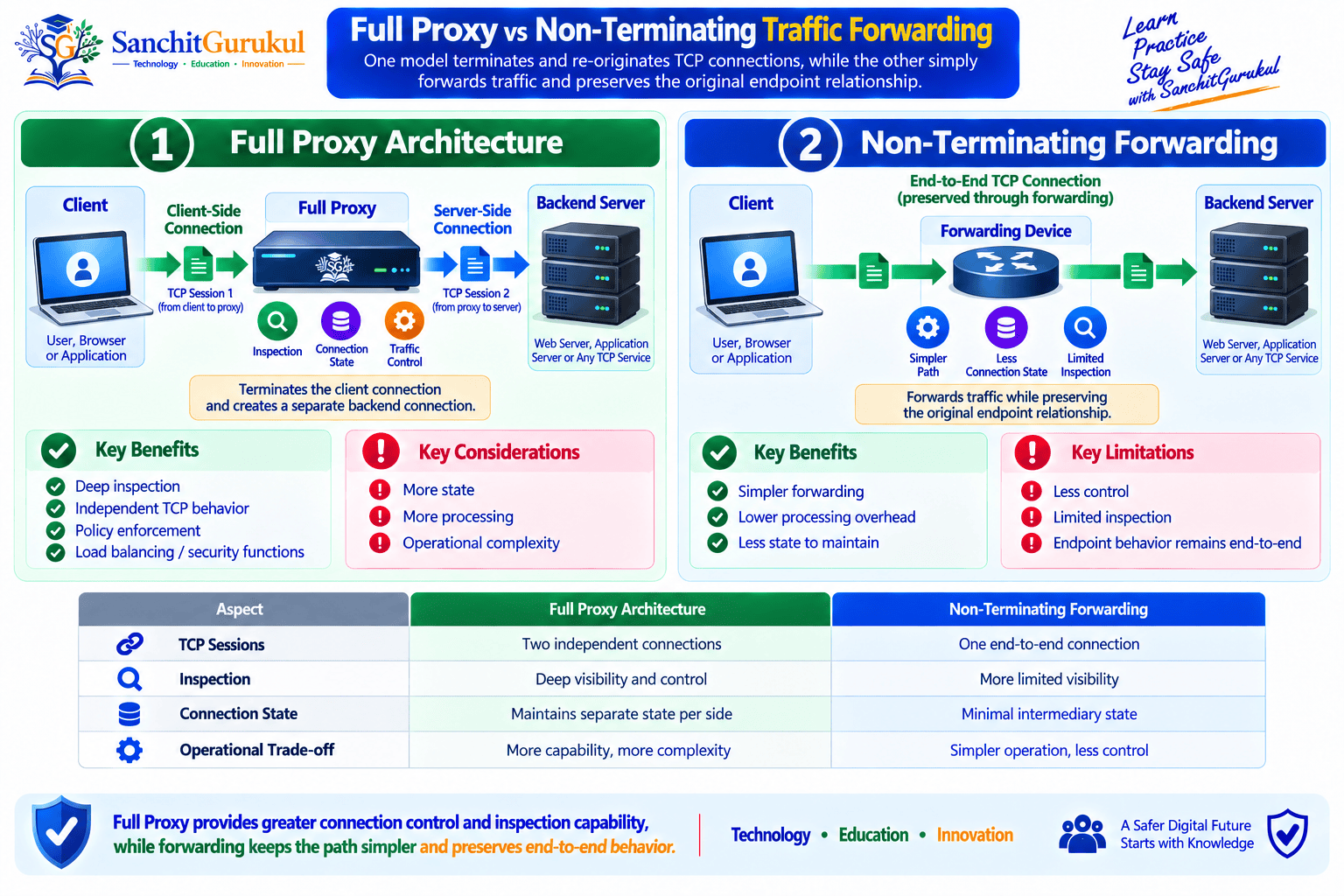
Understanding the Full Proxy Trade-Off
What a Full Proxy Actually Does
In a typical TCP Full Proxy architecture:
Client Side
The client establishes a TCP connection with the proxy.
Server Side
The proxy establishes a separate TCP connection toward the selected backend.
The two connections may maintain independent:
- Sequence numbers
- Receive windows
- Congestion-control state
- Retransmission state
- MSS
- TCP options
- RTT measurements
- Timeouts
- Connection lifetimes
If TLS termination is configured, the proxy may also become the TLS endpoint.
If application-layer inspection is enabled, the proxy may additionally parse application traffic.
These are separate capabilities and should not be treated as one mandatory Full Proxy behavior.
Why This Matters
Every enabled function consumes some combination of:
- CPU
- Memory
- Connection-table capacity
- Cryptographic capacity
- Buffer space
- Logging capacity
- Inspection resources
- Operational effort
The value of Full Proxy should therefore be greater than the cost and complexity it introduces.
When Full Proxy May Be the Wrong Choice
1. When Extremely Low Latency Is More Important Than Inspection
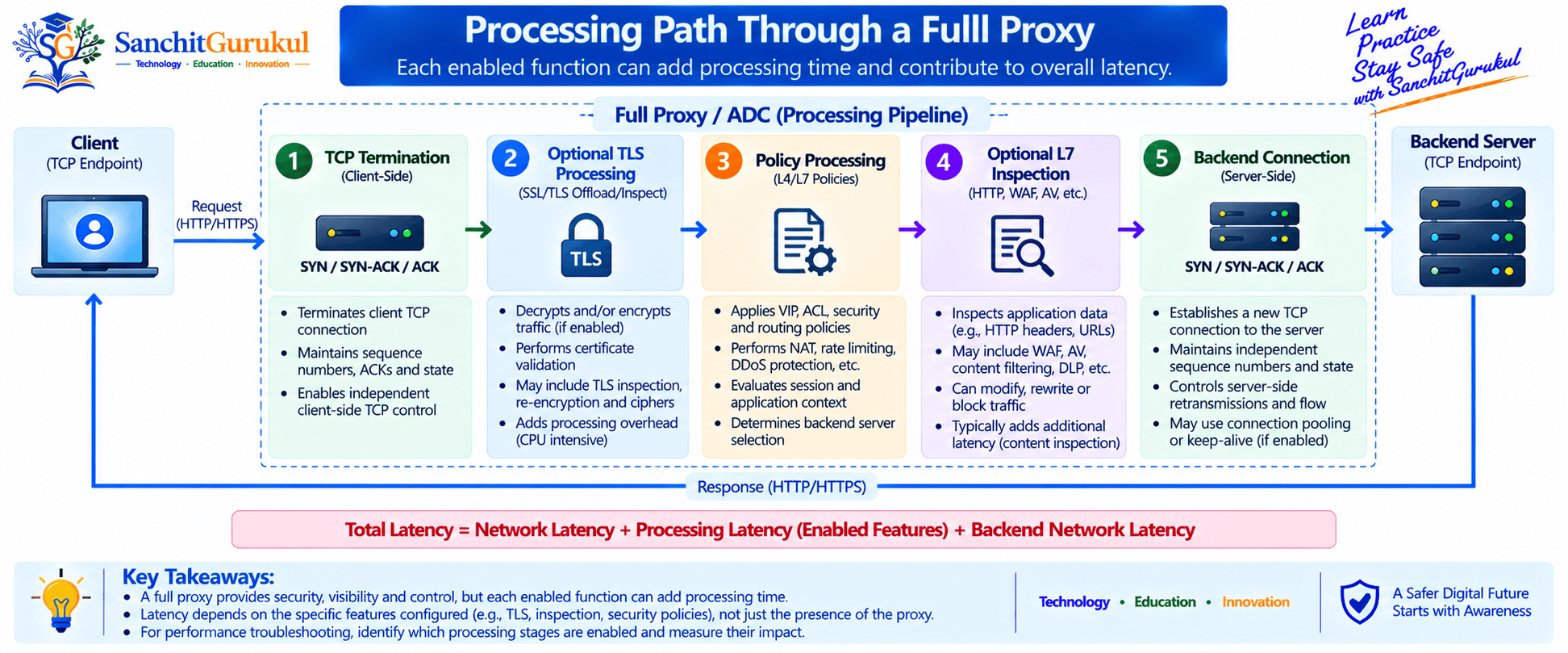
Connection termination introduces processing that simpler forwarding architectures may avoid.
Depending on the configuration, processing can include:
- TCP termination
- Connection establishment
- Buffering
- TLS cryptography
- Application parsing
- Security-policy evaluation
- Logging
- Content modification
This does not mean a Full Proxy always introduces a fixed number of milliseconds of latency.
Modern ADCs and software proxies can process traffic very efficiently, and some proxies may reuse backend connections or establish them in ways that avoid a simple sequential-handshake model.
The correct approach is to measure latency under the expected workload.
Potentially sensitive environments include:
- Electronic trading
- Market-data distribution
- Very latency-sensitive RPC
- Specialized real-time control systems
- Certain gaming architectures
- High-frequency machine-to-machine communication
2. When Connection Termination Provides No Useful Benefit
If the device only needs to:
- Route traffic
- Perform simple forwarding
- Apply basic network ACLs
- Distribute traffic using simple network criteria
then maintaining two independent TCP connections may provide little additional value.
A simpler architecture can reduce:
- State
- Configuration
- Troubleshooting complexity
- Resource usage
- Failure modes
3. When the Application Requires True End-to-End TLS
Full Proxy TCP termination and TLS termination are not the same thing.
A TCP proxy may terminate TCP without necessarily decrypting application TLS, depending on architecture.
However, if the intermediary must inspect HTTPS application content, it normally needs access to the decrypted traffic.
Some application designs require the original client TLS relationship to terminate only at the backend application.
Examples may include environments using:
- Strict end-to-end client certificate authentication
- Application-level certificate binding
- Cryptographic designs that prohibit intermediaries from seeing plaintext
- Organizational policies requiring endpoint-only decryption
In such cases, TLS passthrough or another architecture may be more appropriate.
4. When the Platform Is Undersized
Full Proxy capabilities can become expensive when multiple services are enabled together.
Resource consumption may include:
- TCP connection state
- TLS handshakes
- Symmetric encryption
- WAF inspection
- Compression
- Content transformation
- Logging
- Bot detection
- Authentication
- Connection mirroring
- Packet buffering
An undersized proxy can exhibit:
- Increased latency
- Queueing
- Connection rejection
- TLS handshake failures
- Memory pressure
- CPU saturation
- Dropped connections
Capacity planning should consider more than bandwidth.
Important metrics include:
| Metric | Why It Matters |
|---|---|
| Throughput | Total traffic volume |
| Packets Per Second | Packet-processing demand |
| Connections Per Second | New TCP connection workload |
| Concurrent Connections | State-table and memory demand |
| TLS Handshakes Per Second | Cryptographic workload |
| Requests Per Second | Application-layer workload |
| WAF Transactions | Security-inspection workload |
| Logging Rate | CPU, memory, network and storage impact |
Long-Lived Connections and High Availability
Long-Lived Connections Are Not Automatically a Reason to Avoid Full Proxy
The statement that Full Proxy is generally unsuitable for long-lived connections is too broad.
Full proxies routinely handle protocols and applications containing long-lived TCP connections.
Examples include:
- WebSockets
- Database sessions
- SSH
- Streaming
- Persistent APIs
- Message brokers
- Long polling
The real design questions are:
- How many connections exist simultaneously?
- How much state does each connection consume?
- What timeout is configured?
- Is connection state mirrored?
- What happens during software upgrade or failover?
- Can the application reconnect safely?
Resource Considerations
A large number of idle or persistent sessions can consume:
- Connection-table entries
- Memory
- Timers
- NAT resources
- TLS state
- Persistence state
That does not make Full Proxy inherently unsuitable.
It means capacity and timeout policies must match the application.
Failover Behavior
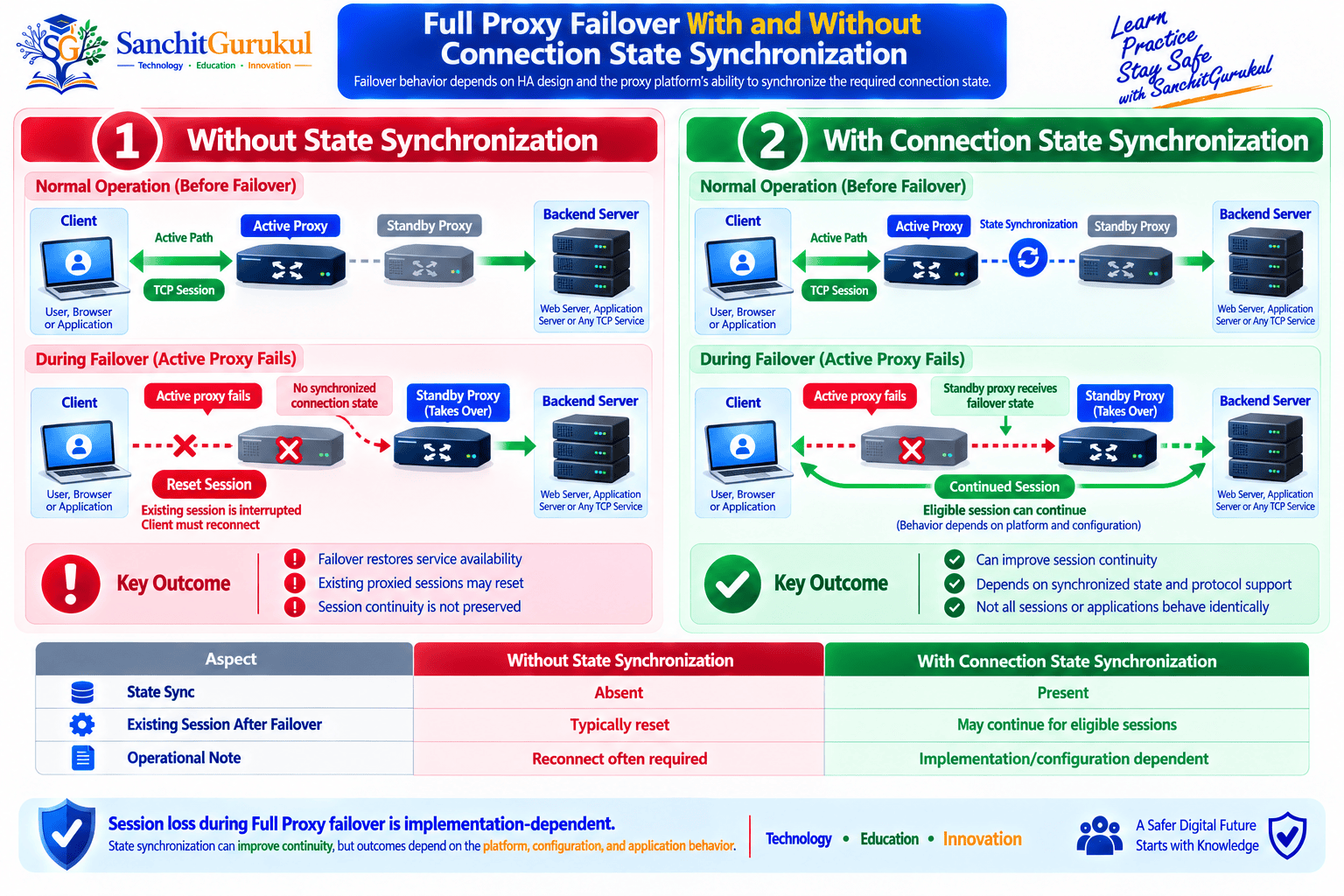
A stateful proxy must account for connection ownership during HA events.
Without appropriate state synchronization, established connections can be interrupted when the active proxy fails.
However, it is incorrect to say:
“Full Proxy failover always resets active sessions.”
Some platforms provide connection-state mirroring or synchronization specifically to maintain connections across failover.
Protocol and Application Compatibility
Non-HTTP Does Not Mean “Do Not Use Full Proxy”
Another common misconception is that Full Proxy should only be used for HTTP, HTTPS, JSON, or XML traffic.
A Full Proxy can operate at the TCP level without understanding the application protocol.
TCP proxying may therefore be used for:
- Database connections
- SMTP
- LDAP
- SSH
- Custom TCP applications
- Message brokers
- Other TCP-based services
Whether Full Proxy is useful depends on the requirement.
Protocol-Aware Processing
Some applications benefit from protocol-specific proxies.
Examples include:
- HTTP reverse proxies
- SMTP relays
- Database proxies
- SIP proxies
- API gateways
These may provide functions that a generic TCP proxy cannot.
Application Transparency
Some applications can be sensitive to intermediaries because they depend on:
- Original client IP
- Source port
- TCP timing
- Certificate identity
- Client certificates
- Long-lived state
- Application-specific connection behavior
Full Proxy may still be usable, but the design might require mechanisms such as:
- PROXY protocol
- Forwarded headers
- Source-address preservation
- Transparent proxying
- Appropriate persistence
- Application-specific health checks
Do not assume that a proxy is either completely transparent or completely incompatible.
Operational and Troubleshooting Complexity
A Full Proxy creates an additional troubleshooting boundary.
Instead of one TCP connection, engineers may need to examine:
Frontend TCP connection
and:
Backend TCP connection
independently.
Packet Capture Implications
Client-side and server-side captures can contain different:
- Sequence numbers
- ACK numbers
- MSS values
- TCP options
- Receive windows
- Source addresses
- Destination addresses
- Source ports
- Retransmissions
- Connection timing
When TLS terminates at the proxy, the encrypted client-side traffic may also correspond to plaintext or separately encrypted backend traffic.
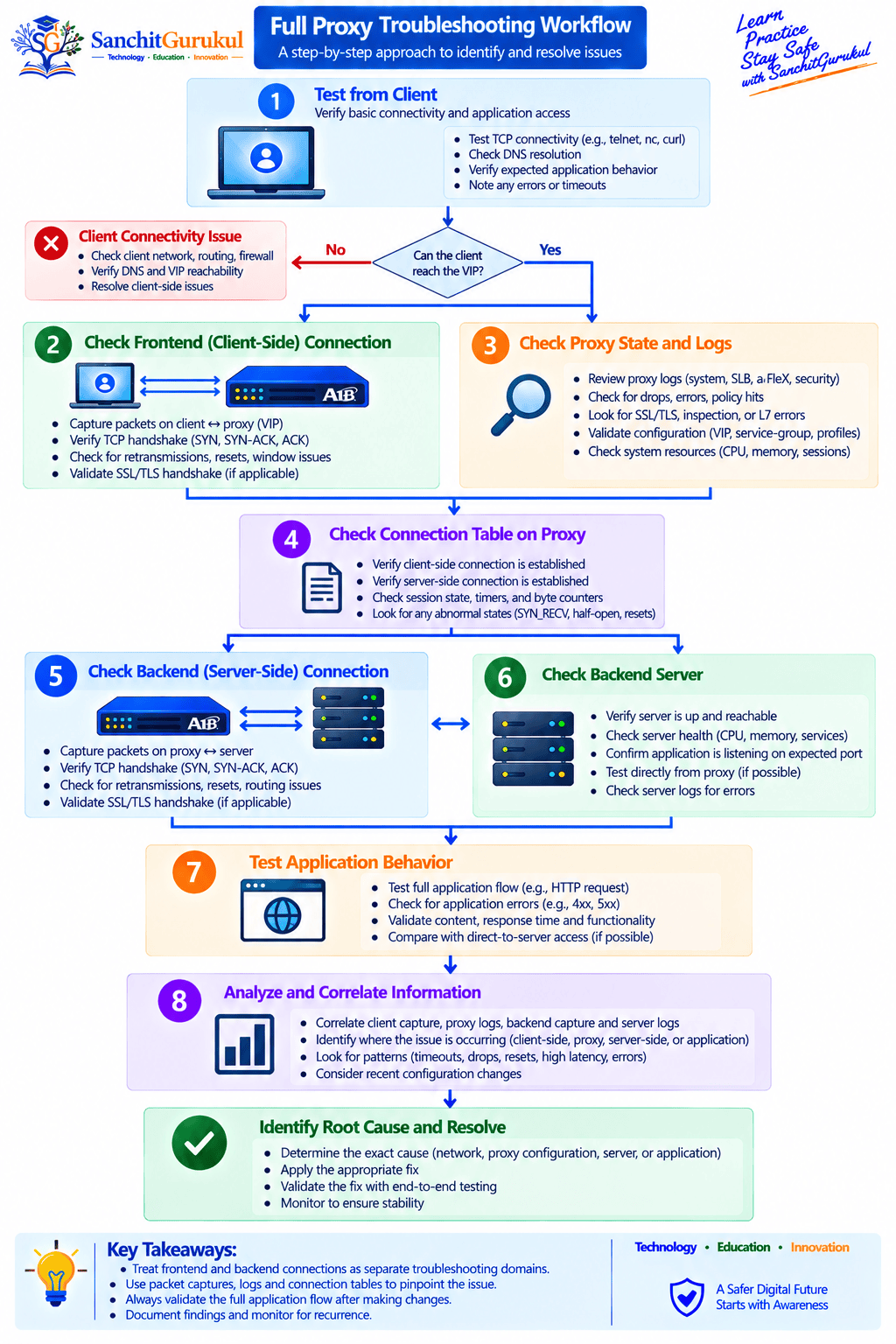
Recommended Troubleshooting Approach
- Confirm the client reaches the proxy.
- Verify the frontend TCP handshake.
- Check the proxy connection table.
- Verify backend selection.
- Confirm the backend TCP handshake.
- Check TLS independently on each applicable side.
- Compare retransmissions.
- Inspect receive windows and Zero Window conditions.
- Check application response timing.
- Correlate proxy logs and backend logs.
Operational Skill Matters
Full Proxy architectures can require engineers to understand:
- TCP
- TLS
- HTTP or application protocols
- Load balancing
- NAT
- Persistence
- Certificates
- WAF policy
- HA
- Packet analysis
If the operations team cannot reliably support those functions, enabling unnecessary features can increase Mean Time to Resolution.
The solution is not necessarily to avoid Full Proxy altogether.
The better approach may be to enable only the functions the team and application actually require.
Choosing Full Proxy or an Alternative
Full Proxy Is Usually Appropriate When
Use Full Proxy when the design needs capabilities such as:
- Independent TCP connections
- Application-aware routing
- TLS termination
- WAF
- Authentication
- Content modification
- Header manipulation
- Connection optimization
- Advanced persistence
- Protocol normalization
- Backend abstraction
Consider a Simpler Architecture When
A simpler forwarding architecture may be preferable when:
- The intermediary does not need to terminate the connection.
- Application payload inspection is unnecessary.
- Original endpoint relationships must be preserved.
- Latency requirements strongly favor minimal processing.
- Available proxy capacity is insufficient.
- Operational complexity outweighs the benefit.
- The security model requires true endpoint-only TLS termination.
Architecture Decision Matrix
| Requirement | Full Proxy | TCP Proxy | TLS Passthrough / Simpler Forwarding |
|---|---|---|---|
| Independent frontend/backend TCP | Yes | Yes | Usually No |
| Basic TCP load balancing | Yes | Yes | Possible |
| HTTP awareness | Possible | No | No |
| WAF inspection | Possible | No | No |
| TLS termination | Possible | Possible | No |
| Preserve endpoint TLS | No when TLS terminated | Possible if TLS remains opaque | Yes |
| Header rewriting | Possible | No | No |
| Minimal processing | Less suitable when many features enabled | Moderate | Usually strongest |
| Deep application inspection | Yes when supported | No | No |
| Backend abstraction | Yes | Yes | Depends on design |

Common Design Mistakes
Mistake 1 — Full Proxy Means L7
Incorrect.
A Full Proxy can terminate TCP without necessarily parsing an application protocol.
Mistake 2 — L4 Means Half Proxy
Incorrect.
Layer 4 describes the transport-layer processing level.
A Layer 4 TCP proxy can still terminate TCP.
Mistake 3 — Non-HTTP Traffic Should Never Use Full Proxy
Incorrect.
Generic TCP proxying can support many non-HTTP TCP protocols.
Mistake 4 — Long-Lived Connections Should Avoid Full Proxy
Too broad.
The key considerations are scale, timeouts, resource capacity, failover, and application reconnect behavior.
Mistake 5 — Full Proxy Always Adds Significant Latency
Incorrect.
Additional processing exists, but actual latency depends on:
- Platform
- Configuration
- Traffic
- TLS
- Inspection
- Load
- Connection reuse
- Hardware acceleration
Measure it.
Mistake 6 — Failover Always Drops Sessions
Not necessarily.
Some products can mirror connection state, although capabilities and limitations are platform-specific.
Mistake 7 — Compliance Automatically Prohibits TLS Decryption
Incorrect.
TLS inspection requirements depend on the applicable policy, regulation, architecture, and data sensitivity.
Key Takeaways and Summary
Key Takeaways
- Full Proxy is an architecture, not simply another name for Layer 7 processing.
- Full Proxy normally creates independent client-side and server-side connections.
- TLS termination and application inspection are optional capabilities depending on design and product.
- Non-HTTP protocols can use TCP-terminating proxies.
- Long-lived connections are not inherently incompatible with Full Proxy.
- Full Proxy can increase processing and operational complexity, but the actual impact must be measured.
- HA connection-state synchronization can preserve eligible sessions on platforms that support it.
- TLS passthrough is appropriate when the backend must remain the TLS endpoint.
- A simpler forwarding architecture can be preferable when proxy capabilities provide no meaningful benefit.
- Use Full Proxy when its capabilities solve a defined application, availability, performance, or security requirement.
Summary
Full Proxy architecture provides a powerful control point between clients and backend applications.
Its ability to terminate connections, maintain independent TCP behavior, inspect applications, terminate TLS, enforce security policy, and manipulate traffic can provide major advantages.
But these capabilities come with costs:
- Additional state
- Resource consumption
- Troubleshooting complexity
- Certificate management
- HA considerations
- Capacity requirements
The objective should therefore not be to avoid Full Proxy or to deploy it everywhere.
The objective is to select the least complex architecture that safely meets the application’s technical and security requirements.
Useful Links and References
SanchitGurukul Static Resources
Official External References
Your feedback matters
Was this post helpful?
Discussion
0 approved comments
No approved comments yet. You can start the discussion below.
Leave a Comment
No login is required. Name and email are used for moderation/security. Your email is never displayed publicly. All comments require administrator approval.
Discover more from SanchitGurukul
Subscribe to get the latest posts sent to your email.