Comprehensive Guide to Cisco ASA Firewall Features

Comprehensive Guide to Cisco ASA Firewall Features
03/21/2025 •

The Cisco ASA (Adaptive Security Appliance) firewall is a cornerstone of Cisco’s network security product line, widely used by enterprises to provide secure communication between networks, protect against attacks, and control access to resources. As a unified threat management device, Cisco ASA integrates a range of advanced features, including firewall protection, VPN capabilities, intrusion prevention, and SSL encryption.

Comprehensive Guide to Cisco ASA Firewall Features

1. What is Cisco ASA Firewall?

The Cisco ASA firewall is a security appliance designed to protect networks from external threats by providing stateful firewalling, VPN termination, intrusion detection/prevention, content filtering, and more. Launched in the early 2000s, Cisco ASA is built on a solid foundation of firewall protection with enhanced features like Next-Generation Firewall (NGFW) capabilities, combining traditional firewall functions with advanced security features such as Deep Packet Inspection (DPI) and application-level protection.

Cisco ASA Firewall is available in both hardware and virtual form factors, meaning it can be deployed on physical appliances or as a virtual firewall in cloud environments (Cisco ASAv). It is a flexible and scalable solution, ranging from small office deployments to large enterprise networks.


2. Key Components of Cisco ASA Firewall

The Cisco ASA firewall consists of several key components, each playing a crucial role in network security and traffic management.

2.1 Stateful Firewall

At the core of Cisco ASA Firewall is a stateful firewall that tracks and inspects the state of active connections. Unlike a stateless firewall, which examines each packet in isolation, a stateful firewall monitors the entire communication session, keeping track of packet sequences to ensure they are part of legitimate conversations. This allows for more efficient traffic filtering and a higher level of security.

2.2 NAT (Network Address Translation)

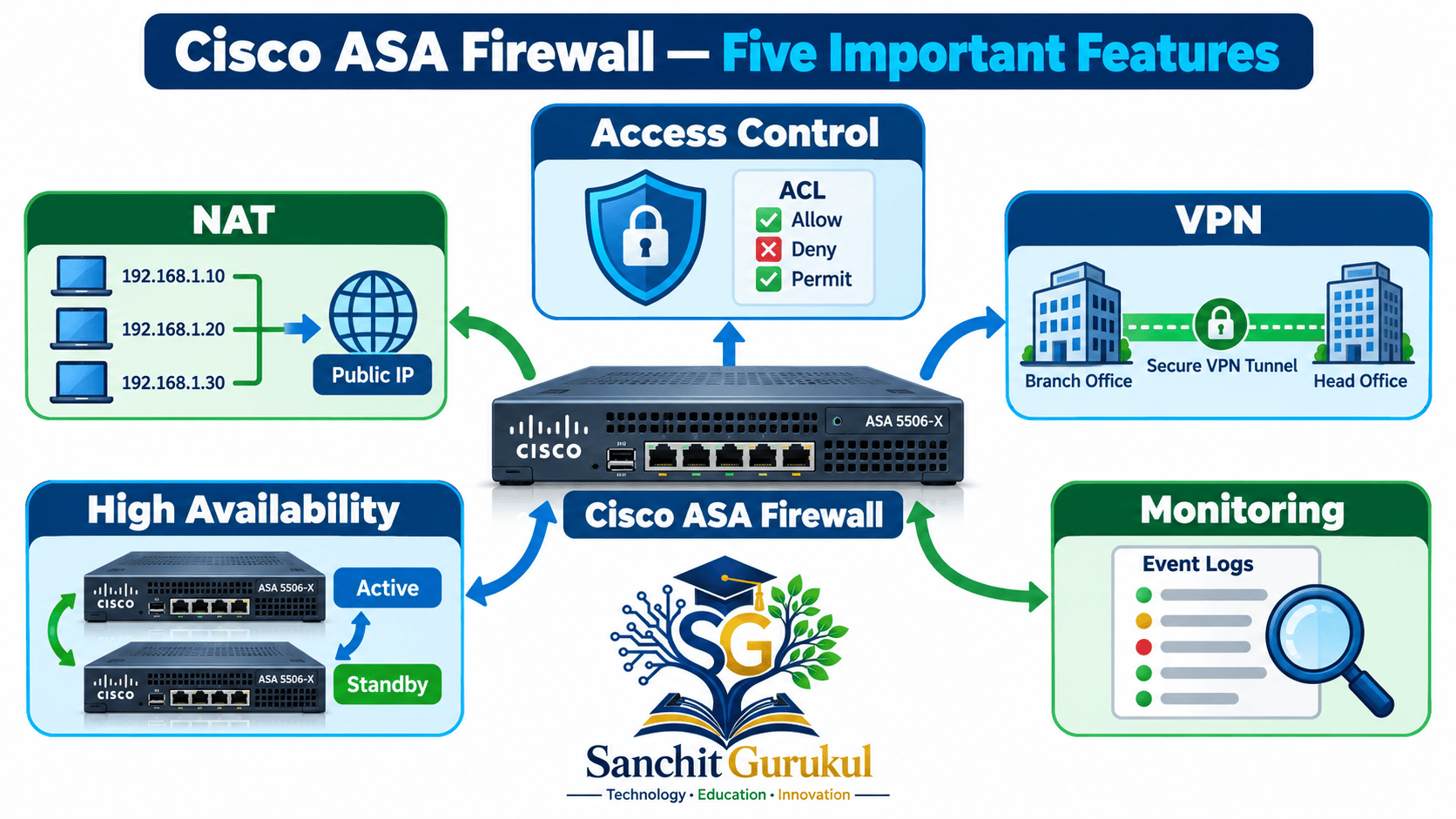
Cisco ASA Firewall supports NAT, which allows organizations to map internal, private IP addresses to external, public IP addresses, providing both privacy and conservation of public IP space. NAT functionality in ASA includes static NAT, dynamic NAT, and Port Address Translation (PAT).

2.3 VPN (Virtual Private Network) Capabilities

Cisco ASA includes robust VPN capabilities, supporting both IPSec VPN and SSL VPN for secure remote access and site-to-site communication. This ensures that users can access internal resources securely over untrusted networks, such as the internet.

  • IPSec VPN: Ideal for site-to-site VPNs where multiple branch offices need secure, encrypted communication.
  • SSL VPN: Commonly used for remote access VPNs where employees connect to the corporate network from remote locations via a web browser or a VPN client like Cisco AnyConnect.

2.4 Intrusion Prevention System (IPS)

Cisco ASA Firewall can integrate with Cisco’s IPS technology to detect and prevent security threats by scanning network traffic for malicious activities and known attack patterns. While IPS is not enabled by default in all ASA models, it can be added as an additional security layer to protect against sophisticated threats.

2.5 Application Layer Security

As a Next-Generation Firewall (NGFW), the Cisco ASA offers application-layer security that enables administrators to control and filter traffic based on the application being used (e.g., HTTP, FTP, DNS). This provides more granular control than traditional port-based firewalls, allowing the network to enforce policies based on the specific applications or services users are accessing.

2.6 Content Filtering

Cisco ASA Firewall can perform content filtering using URL filtering and malware detection services, blocking access to malicious websites or suspicious content based on predefined policies. This feature enhances web security by preventing users from accessing known harmful domains.

2.7 Failover and High Availability (HA)

Cisco ASA supports failover configurations, which enable two or more ASA devices to work together to provide redundancy. Active/Standby and Active/Active failover options allow businesses to maintain service continuity in the event of device failure, ensuring minimal downtime.

2.8 Cisco FirePOWER Services

FirePOWER is a subscription-based service that can be integrated with the Cisco ASA firewall to enhance its security capabilities. FirePOWER includes Intrusion Prevention System (IPS), Advanced Malware Protection (AMP), and URL filtering, delivering more advanced threat detection and prevention capabilities.

2.9 Management and Monitoring

Cisco ASA Firewall provides multiple methods for managing and monitoring the firewall:

  • Cisco ASDM (Adaptive Security Device Manager): A graphical user interface (GUI) for managing the firewall, useful for administrators who prefer a visual interface.
  • CLI (Command-Line Interface): A more advanced interface for administrators who prefer command-based configurations.
  • Cisco Security Manager: A centralized management tool for managing multiple ASA devices and other Cisco security appliances.
  • Syslog and SNMP: Monitoring and logging capabilities to integrate with third-party systems for real-time alerts and reporting.

3. Comparison with Other Vendor Firewalls

When comparing Cisco ASA Firewall with other popular firewall vendors, it’s important to look at its capabilities in terms of security features, performance, ease of management, integration, and cost.

3.1 Cisco ASA vs. Palo Alto Networks

Palo Alto Networks offers Next-Generation Firewalls with a strong focus on application-layer security and threat prevention. Compared to Cisco ASA, Palo Alto is known for its:

  • Application Visibility and Control: Palo Alto has advanced application-layer security, providing more granular control over applications, user identification, and data filtering.
  • Threat Intelligence Cloud: Palo Alto integrates with its WildFire threat intelligence service for cloud-based malware analysis.

Cisco ASA Strengths:

  • Mature VPN Capabilities: Cisco ASA excels in VPN configurations, particularly with AnyConnect and IPSec Site-to-Site VPNs.
  • Broad Ecosystem Integration: Cisco ASA integrates well with other Cisco products, making it ideal for businesses with existing Cisco networks.

Cisco ASA Weaknesses:

  • Limited Application Awareness: Cisco ASA, especially in its base form without FirePOWER, lags behind Palo Alto in terms of application visibility and control.

3.2 Cisco ASA vs. Fortinet FortiGate

Fortinet FortiGate is another competitor in the NGFW space, known for offering strong security features and competitive pricing.

Fortinet Strengths:

  • Unified Threat Management (UTM): FortiGate integrates firewalling, intrusion prevention, antivirus, and web filtering into a single solution.
  • Cost-Effective: FortiGate is generally more affordable than Cisco ASA for small and medium-sized businesses (SMBs).
  • Custom ASIC Chips: FortiGate devices use custom-built ASIC chips for high-performance firewall and IPS tasks.

Cisco ASA Strengths:

  • Advanced VPN Features: Cisco ASA’s AnyConnect VPN solution is still the gold standard for remote access VPNs.
  • Extensive Support: Cisco offers extensive support through its TAC (Technical Assistance Center) and its community network, making troubleshooting and scaling easier.

3.3 Cisco ASA vs. Check Point

Check Point is another leader in the firewall market, offering a wide range of NGFW features.

Check Point Strengths:

  • Comprehensive Threat Prevention: Check Point’s NGFW offers extensive threat prevention features, including advanced malware protection and sandboxing.
  • Centralized Management: Check Point’s SmartConsole is a unified management platform that makes it easy to manage security policies across large networks.

Cisco ASA Strengths:

  • Simple Interface for VPNs: While Check Point’s VPN features are extensive, Cisco ASA provides a more streamlined configuration process for VPNs, especially for organizations heavily invested in Cisco technology.

4. Benefits of Cisco ASA Firewall

  1. Comprehensive Security: Cisco ASA combines multiple security functions, including firewalling, VPN, IPS, and content filtering, into a single device, providing a multi-layered defense against network attacks.
  2. Scalability: Cisco ASA can be deployed across a wide range of network environments, from small businesses to large enterprises and cloud environments (using Cisco ASAv).
  3. Robust VPN Capabilities: Cisco ASA offers industry-leading VPN solutions, including AnyConnect for remote access and IPSec VPN for site-to-site communication.
  4. High Availability: Cisco ASA supports active/standby and active/active failover configurations, ensuring high availability and minimal downtime in case of device failure.
  5. Integration with Cisco Ecosystem: Cisco ASA integrates seamlessly with other Cisco products, such as Cisco FirePOWER, Cisco ISE, and Cisco DNA Center, providing enhanced functionality and centralized management.
  6. Flexible Deployment Options: Cisco ASA can be deployed as a physical appliance or as a virtual firewall (ASAv) in cloud environments like AWS, Azure, and VMware.

5. Advantages of Cisco ASA Firewall

  • Wide Range of Models: Cisco ASA is available in multiple hardware models, making it adaptable for various use cases, from small office deployments to large enterprise environments.
  • Mature VPN Capabilities: Cisco ASA is known for its strong VPN support, including AnyConnect and site-to-site IPSec VPNs, which are essential for secure remote work environments.
  • Extensive Support: Cisco provides a vast amount of support options through its global TAC (Technical Assistance Center) and extensive documentation.
  • Seamless Cisco Integration: Organizations that already use Cisco products will benefit from seamless integration between ASA firewalls and other Cisco solutions like Cisco ISE, Cisco DNA, and FirePOWER Services.

6. Disadvantages of Cisco ASA Firewall

  • Cost: Cisco ASA can be more expensive than competitors, especially when adding features like FirePOWER or advanced threat detection services.
  • Limited NGFW Capabilities without FirePOWER: Out of the box, the ASA is a stateful firewall with limited application visibility. To turn it into a full NGFW, the FirePOWER services need to be purchased, which adds complexity and cost.
  • Complex Configuration for Beginners: The CLI-based configuration can be complex for administrators without deep networking and security knowledge. Although ASDM provides a graphical interface, it has a learning curve.

7. Summary

The Cisco ASA firewall remains one of the most widely used network security appliances globally, known for its reliability, flexibility, and robust security features. It serves as both a traditional stateful firewall and, with the addition of Cisco FirePOWER Services, as a Next-Generation Firewall (NGFW). Its strong VPN capabilities, especially AnyConnect, make it a top choice for organizations requiring secure remote access.

When compared to competitors like Palo Alto, Fortinet, and Check Point, the ASA’s strength lies in its VPN capabilities and seamless integration with the Cisco ecosystem. However, its base form lacks some of the advanced NGFW features offered by its competitors unless FirePOWER services are added.

Key benefits include comprehensive security features, scalability, seamless integration with other Cisco products, and industry-leading VPN solutions. On the downside, ASA firewalls can be costly when fully configured and require expertise for setup and management. Additionally, its Next-Generation Firewall (NGFW) capabilities are limited without the purchase of FirePOWER services.

In summary, Cisco ASA is ideal for organizations seeking a highly secure, scalable, and integrated security appliance that fits well within a Cisco-centric network environment. Its extensive VPN capabilities, high availability options, and broad support make it suitable for businesses of all sizes, although it may be overkill for small businesses looking for a simple, cost-effective firewall solution.

https://www.cisco.com/c/en_in/products/security/adaptive-security-appliance-asa-software/index.html

https://sanchitgurukul.com/tutorials-cat

Comprehensive Guide to Cisco ASA Firewall Features

This article provided insights on the topic. For latest updates and detailed guides, stay connected with Sanchit Gurukul.

Disclaimer: This article may contain information that was accurate at the time of writing but could be outdated now. Please verify details with the latest vendor advisories or contact us at admin@sanchitgurukul.com.

Discover more from

Subscribe now to keep reading and get access to the full archive.

Continue reading