
Introduction
A proxy or traffic-processing device sits between a client and a server, but not every intermediary handles connections in the same way.
One of the most important architectural differences is whether the intermediary independently manages the client-facing and server-facing connections or primarily maintains state while forwarding and inspecting an existing traffic flow.
These approaches are commonly discussed using terms such as:
- Full Proxy
- Half Proxy
- Flow-Based Processing
- Stateful Forwarding
- Layer 4 Processing
The easiest way to remember the fundamental difference is:
Full Proxy = independent client-side and server-side connection handling
Half Proxy / Flow-Oriented Processing = less connection separation and more forwarding-oriented traffic handling
Understanding Full Proxy and Half Proxy
Before comparing security, TLS, or performance, first understand what happens to the connection.
What Is a Full Proxy?
A Full Proxy acts as an endpoint toward the client and independently communicates with the backend server.
For TCP traffic, the basic concept is:
Client → TCP Connection 1 → Full Proxy → TCP Connection 2 → Backend Server
The client establishes TCP Connection 1 with the Full Proxy.
The Full Proxy independently establishes and manages TCP Connection 2 with the backend server.

This separation gives the Full Proxy significant control over both sides of the communication.
Depending on the product and configuration, it may provide:
- Independent TCP handling
- TCP optimization
- Connection pooling
- Connection reuse
- TLS termination
- TLS re-encryption
- HTTP inspection
- Header modification
- Cookie manipulation
- URL-based routing
- Application-aware load balancing
- WAF integration
- API security
- Bot protection
What Is a Half Proxy?
The term Half Proxy is commonly used to describe architectures where an intermediary maintains traffic state and applies forwarding, load-balancing, or security decisions without providing the same degree of independent connection handling as a classic Full Proxy.
A simplified conceptual path is:
Client → Stateful Intermediary → Backend Server

Depending on the implementation, the intermediary may perform:
- Stateful connection tracking
- NAT
- ACL enforcement
- Routing decisions
- Layer 4 load balancing
- SYN protection
- Connection limiting
- Rate limiting
- Selected protocol inspection
- Application identification
Quick Side-by-Side Comparison
| Aspect | Full Proxy | Half Proxy / Flow-Oriented |
|---|---|---|
| Connection handling | Independent client and server sides | More closely associated with original traffic flow |
| TCP connection separation | High | Lower / implementation dependent |
| TCP optimization | Strong | Implementation dependent |
| Connection pooling | Common | Usually more limited |
| TLS termination | Common | Product/mode dependent |
| Layer 7 visibility | Strong when traffic is available for inspection | Product/mode dependent |
| HTTP manipulation | Common | Usually more limited |
| Stateful inspection | Yes | Yes |
| Application awareness | High | Varies |
| Processing overhead | Generally higher | Generally lower |
| Raw forwarding efficiency | Generally lower | Generally higher |
TCP, TLS and Layer 7 Behavior
The difference between the two architectures becomes much clearer when TCP and HTTPS traffic are examined.
TCP Behavior in a Full Proxy
A Full Proxy independently participates in the client-facing and server-facing TCP communication.
The basic TCP architecture is:
Client ↔ TCP Connection 1 ↔ Full Proxy ↔ TCP Connection 2 ↔ Backend Server
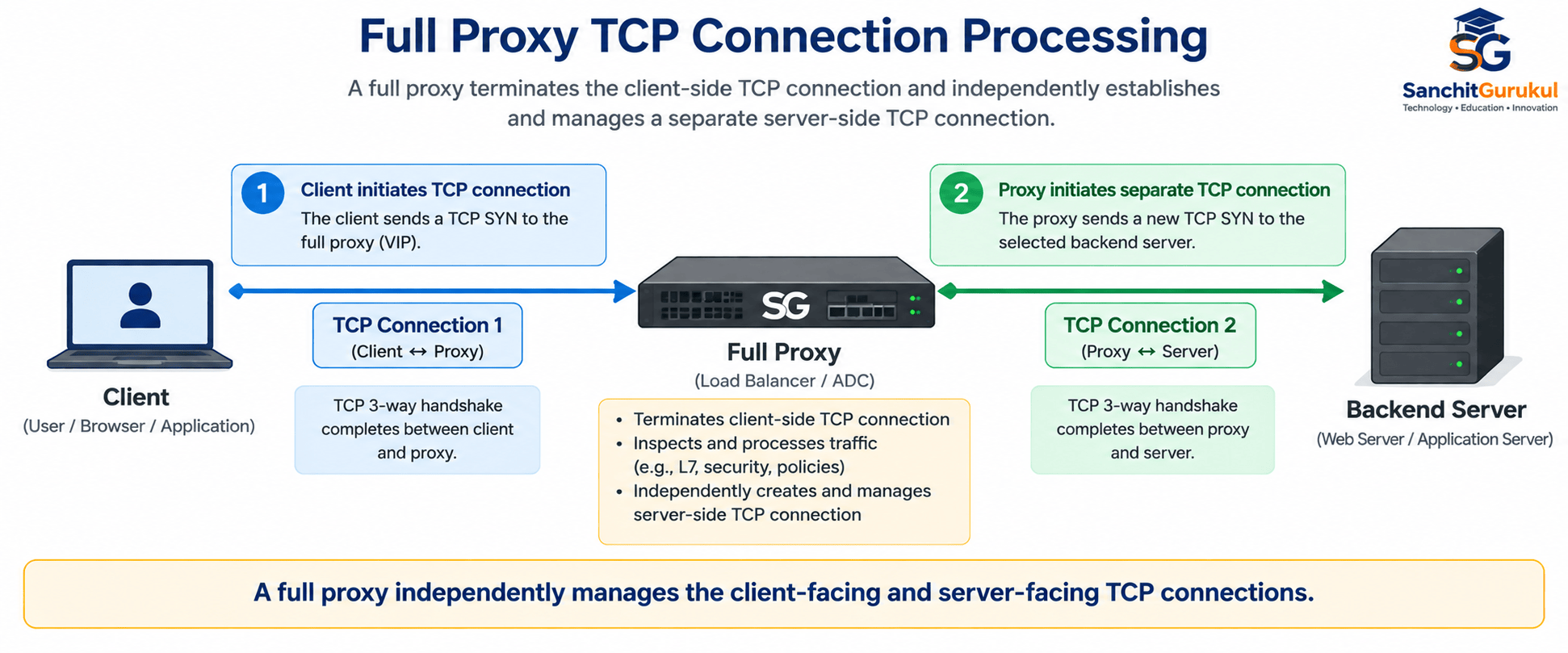
This architecture allows the two TCP connections to be managed differently.
Client-Side TCP Connection
The client-facing connection may be optimized for:
- Internet latency
- WAN conditions
- Mobile users
- Client MSS
- Client receive window
- Slow client behavior
- Internet congestion characteristics
Server-Side TCP Connection
The backend-facing connection may separately be optimized for:
- Data-center latency
- Backend server characteristics
- Connection reuse
- Connection pooling
- Server-side TCP tuning
- High-speed internal networks
TCP Behavior in Half Proxy / Flow-Oriented Processing
A flow-oriented intermediary normally maintains state and applies policy while preserving more of the original traffic relationship.
Depending on the platform, it may:
- Track TCP state
- Validate SYN and ACK behavior
- Perform NAT
- Apply security policy
- Apply connection limits
- Select a destination
- Perform Layer 4 load balancing
- Inspect supported application information
The amount of independent TCP control varies by implementation.
TLS and HTTPS Handling
TLS termination is one of the major capabilities associated with application proxying.
A TLS-terminating Full Proxy can:
- Receive an encrypted TLS connection from the client.
- Terminate the client-side TLS session.
- Inspect authorized decrypted application traffic.
- Apply security or routing policy.
- Establish a separate connection toward the backend.
- Optionally encrypt the backend connection again.

For example:
Client-facing connection: TLS 1.3
Backend-facing connection: TLS 1.2
The proxy may also use different:
- Certificates
- Cipher suites
- TLS versions
- Security policies
- Connection settings
on the two sides.
TLS Offloading
In some architectures, TLS terminates at the proxy and the backend connection uses HTTP.
For example:
Client → HTTPS → Full Proxy → HTTP → Backend Server
Layer 7 Visibility
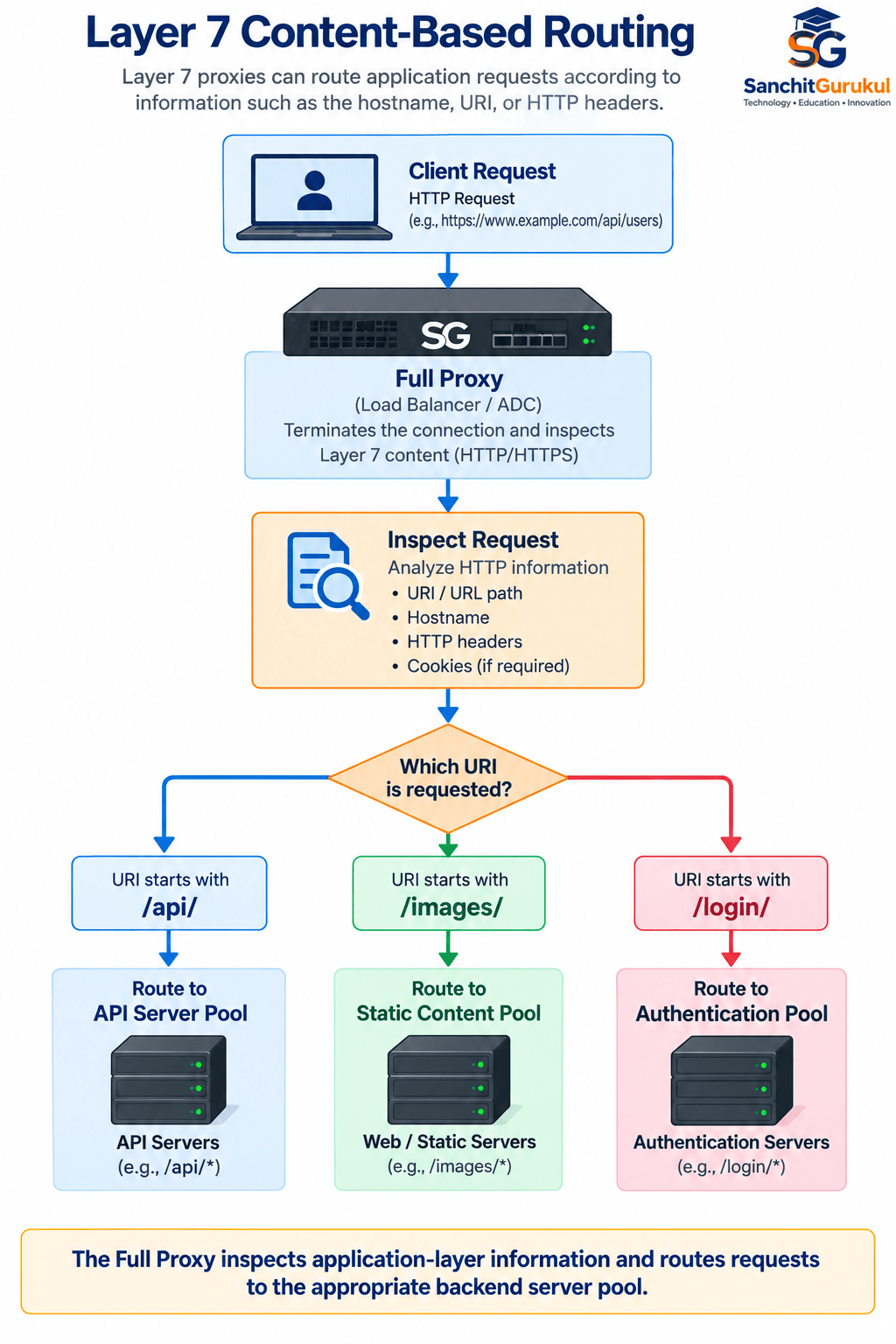
After authorized TLS termination, an application proxy can potentially inspect information such as:
- HTTP method
- Host header
- URI
- Cookies
- Request headers
- Response headers
- HTTP status
- Content type
- Application payload
This allows application-aware traffic decisions.
For example:
/api/ → API Server Pool
/images/ → Static Content Pool
/login/ → Authentication Pool
Security, Performance and DDoS Protection
Full Proxy and flow-oriented architectures make different trade-offs between processing depth, security visibility, and forwarding efficiency.
Full Proxy Security Capabilities
A Full Application Proxy can become a strong security enforcement point because it can understand the application transaction when traffic is available for inspection.
Possible capabilities include:
- Web Application Firewall
- SQL injection detection
- Cross-site scripting detection
- API security
- Bot mitigation
- TLS policy enforcement
- HTTP rate limiting
- Request validation
- Credential-abuse detection
- Application-aware DDoS protection
Half Proxy / Flow-Oriented Security
A flow-oriented security device can also provide significant protection.
Capabilities may include:
- Stateful firewalling
- Layer 3 and Layer 4 ACLs
- NAT
- SYN flood protection
- Connection limiting
- Rate limiting
- Application identification
- Threat inspection
- TLS decryption when supported and configured
Performance Trade-Off
A Full Proxy normally performs more connection and application processing.
A request may require the platform to:
- Accept the client connection.
- Maintain client-side connection state.
- Process TLS.
- Parse the application protocol.
- Apply security policy.
- Select a backend.
- Establish or manage a backend connection.
- Process the backend response.
- Return the response to the client.
A simpler flow-oriented architecture may perform fewer application-level operations.
| Metric | Full Proxy | Half Proxy / Flow-Oriented |
|---|---|---|
| Processing complexity | Higher | Generally lower |
| CPU requirement | Generally higher | Generally lower |
| TLS processing | Potentially significant | Configuration dependent |
| Layer 7 inspection | Strong | Product dependent |
| Raw forwarding efficiency | Generally lower | Generally higher |
| Connection optimization | Strong | Implementation dependent |
| Application intelligence | High | Varies |
DDoS Protection
DDoS protection should be considered according to the attack layer.
Layer 3 / Layer 4 Attacks
Examples include:
- SYN floods
- UDP floods
- Connection floods
- Abnormal connection rates
These attacks can be mitigated by:
- Firewalls
- ADCs
- Dedicated DDoS platforms
- Cloud DDoS services
- Network infrastructure
Layer 7 Attacks
Examples include:
- HTTP request floods
- Expensive API requests
- Login abuse
- Slow HTTP attacks
- Automated bot traffic
Application-aware security platforms have an advantage when mitigation requires understanding the actual application request.
Traffic Flow and Practical Use Cases
The correct traffic-processing architecture depends on what the application actually requires.
Full Proxy Request Flow
A simplified Full Proxy request flow is:
- Client establishes a connection with the Full Proxy.
- The Full Proxy accepts the client-side connection.
- TLS may terminate at the proxy.
- Application traffic may be inspected.
- Security and routing policies are applied.
- A backend server is selected.
- The proxy establishes or manages the backend-side connection.
- The request is sent to the backend.
- The backend responds to the proxy.
- The proxy processes and returns the response to the client.
The important concept is:
The Full Proxy independently participates on both sides of the communication.
Half Proxy / Flow-Oriented Request Flow
A simplified flow-oriented process may be:
- Client traffic reaches the intermediary.
- Connection state is evaluated.
- Security or forwarding policy is applied.
- NAT or load-balancing decisions may be performed.
- Permitted traffic continues toward the backend.
- Return traffic is associated with the tracked flow.
When Full Proxy Is Useful
Full Proxy architectures are particularly useful when you require:
- Layer 7 load balancing
- TLS termination
- TLS policy control
- Web Application Firewall
- API security
- HTTP header modification
- Cookie processing
- URL-based routing
- Application-aware traffic distribution
- Connection pooling
- Backend connection optimization
- Bot mitigation
- Advanced application delivery
Typical environments include:
- Public websites
- Enterprise applications
- Banking applications
- E-commerce platforms
- APIs
- SaaS applications
- Application delivery platforms
- Web application security environments
When Half Proxy / Flow-Oriented Processing Is Useful
Flow-oriented processing may be suitable when the primary requirements are:
- High throughput
- Lower processing overhead
- Stateful firewalling
- Network-layer forwarding
- Layer 4 traffic distribution
- Large connection volumes
- Minimal application modification
Vendor and Implementation Considerations
Vendor terminology must be handled carefully.
It is better to compare processing modes and capabilities than to classify an entire vendor as either Full Proxy or Half Proxy.
General Vendor Examples
| Platform / Technology | Proxy-Oriented Capability | Flow / L4 Capability |
|---|---|---|
| F5 BIG-IP | Full-proxy and application-delivery capabilities | FastL4 and other traffic-processing profiles |
| A10 Thunder ADC | ADC and application-proxy capabilities | High-performance L4 processing capabilities |
| Fortinet FortiGate | Proxy-based inspection for supported security functions | Flow-based inspection |
| NGINX / NGINX Plus | HTTP reverse proxy and application gateway | TCP/UDP stream proxying |
| Citrix NetScaler | Application delivery and proxy capabilities | L4 traffic handling capabilities |
| Cloud reverse proxies | Commonly terminate client-facing application connections | Architecture varies by provider |
| Traditional stateful firewalls | Product dependent | Commonly stateful/flow oriented |
F5 BIG-IP Example
F5 BIG-IP provides full-proxy application-delivery capabilities.
A Full Proxy deployment can independently process client-side and server-side traffic.
Depending on the configuration, separate profiles can be applied to the two sides so that traffic does not have to be handled identically.
FortiGate Example
FortiGate supports different traffic-inspection approaches depending on configuration, FortiOS version, protocol, and enabled security functions.
Do not simplify the architecture to:
FortiGate = Half Proxy
Instead, determine:
- Inspection mode
- Security profile
- SSL/TLS inspection configuration
- Application protocol
- Firewall policy
- FortiOS version
NGINX Example
NGINX can operate as an HTTP reverse proxy.
It can:
- Receive client requests
- Forward requests toward upstream servers
- Modify selected request headers
- Receive backend responses
- Return responses to clients
NGINX can also proxy TCP and UDP services using stream functionality.
The available application visibility and processing therefore depend on the protocol and configuration.
NetScaler Example
NetScaler load-balancing virtual servers can act as intermediaries between clients and backend servers.
In a typical load-balancing configuration, the virtual server can terminate the client connection and establish a new connection toward the selected backend server or reuse an appropriate existing backend connection.
This is another practical example of independently managed client-side and server-side communication.
Common Questions and Architecture Selection
Which Architecture Is Better?
There is no universal winner.
| Requirement | Generally Preferred Approach |
|---|---|
| Advanced Layer 7 control | Full Proxy |
| TLS termination | Full/Application Proxy |
| WAF | Full/Application Proxy |
| API security | Full/Application Proxy |
| URL-based routing | Full Proxy |
| HTTP header modification | Full Proxy |
| Connection pooling | Full Proxy |
| Independent backend TCP optimization | Full Proxy |
| Maximum raw L4 forwarding efficiency | Flow/L4-oriented processing |
| Minimal application processing | Flow/L4-oriented processing |
| Stateful firewalling | Flow-oriented or platform dependent |
| Application-aware DDoS controls | Application-aware security platform |
Does Full Proxy Mean Two TCP Connections?
For classic TCP Full Proxy architecture, yes—the key concept is independent client-side and server-side TCP connections.
The client establishes a TCP connection with the proxy.
The proxy independently establishes and manages a separate TCP connection toward the backend server.
Does Half Proxy Always Mean One End-to-End TCP Session?
No.
That description is too absolute.
“Half Proxy” is used differently across products and documentation.
Always verify the specific implementation.
Can a Flow-Based Firewall Perform Layer 7 Inspection?
Yes.
Modern firewalls can perform:
- Application identification
- Threat inspection
- URL filtering
- Content inspection
- TLS decryption
even when their primary processing architecture is flow based.
Does Full Proxy Automatically Mean Higher Latency?
A Full Proxy generally performs more processing, but that does not automatically mean users will experience significant additional latency.
Actual performance depends on:
- Platform capacity
- Hardware acceleration
- TLS processing
- Security policies
- Application behavior
- Network latency
- Configuration
- Current traffic load
Is TLS Offloading Only Available With Full Proxy?
TLS termination is strongly associated with application proxying, but product capabilities vary.
The important question is whether the intermediary actually terminates or decrypts the TLS session.
How Should I Choose?
Ask the following questions:
- Do I need TLS termination?
- Do I need WAF?
- Do I need API security?
- Do I need Layer 7 routing?
- Do I need URL or header manipulation?
- Do I need independent client-side and server-side TCP optimization?
- Do I primarily need very high Layer 4 throughput?
- How much application visibility is required?

Summary
The easiest way to understand Full Proxy vs Half Proxy is to focus on:
Connection ownership
and
Processing depth
Full Proxy
A Full Proxy independently manages the client-facing and server-facing communication.
For classic TCP proxying:
Client → TCP Connection 1 → Full Proxy → TCP Connection 2 → Backend Server
This architecture is particularly useful for:
- Independent TCP optimization
- TLS termination
- Application inspection
- WAF
- API security
- Layer 7 load balancing
- HTTP manipulation
- Connection pooling
- Backend connection optimization
The trade-off is generally greater processing complexity and resource consumption.
Half Proxy / Flow-Oriented Processing
A flow-oriented intermediary maintains traffic state and applies forwarding or security policies with less independent connection separation.
It may provide:
- High throughput
- Lower processing overhead
- Stateful inspection
- Layer 3 and Layer 4 policy enforcement
- Efficient traffic forwarding
- Additional Layer 7 capabilities depending on the platform
Final Side-by-Side Comparison
| Area | Full Proxy | Half Proxy / Flow-Oriented |
|---|---|---|
| Connection independence | High | Lower / implementation dependent |
| Client/server TCP separation | Explicit in classic TCP Full Proxy | Implementation dependent |
| TCP optimization | Strong | Product dependent |
| Layer 7 control | Strong | Product dependent |
| TLS termination | Common | Product/mode dependent |
| WAF integration | Common | Product/mode dependent |
| HTTP manipulation | Strong | Usually more limited |
| Application routing | Strong | Product dependent |
| Raw forwarding efficiency | Generally lower | Generally higher |
| Processing overhead | Higher | Generally lower |
| Stateful inspection | Yes | Yes |
Useful Links and References
SanchitGurukul Static Resources
Official External References
Your feedback matters
Was this post helpful?
Discussion
0 approved comments
No approved comments yet. You can start the discussion below.
Leave a Comment
No login is required. Name and email are used for moderation/security. Your email is never displayed publicly. All comments require administrator approval.
Discover more from SanchitGurukul
Subscribe to get the latest posts sent to your email.