
Finding a new job can be exciting.
You may receive a message:
“Congratulations! Your profile has been selected.”
The salary looks excellent.
The company appears well known.
The recruiter says:
“No interview required.”
Then comes another message:
“Pay ₹2,500 registration fee to confirm your position.”
This is where a promising opportunity may turn into a job scam.
A job scam is a fraudulent employment offer designed to steal:
- Money
- Personal information
- Identity documents
- Banking information
- Account credentials
The National Cyber Crime Reporting Portal defines Online Job Fraud as an attempt to defraud people seeking employment by giving them false hope or promises of better employment with higher wages.
A simple definition is:
Job Scam = A Fake Employment Opportunity Used to Steal Money, Personal Information or Access
CERT-In warns that job seekers—particularly fresh graduates—can be targeted through fake job listings on legitimate job portals and social media, followed by demands for application, training or background-check fees.
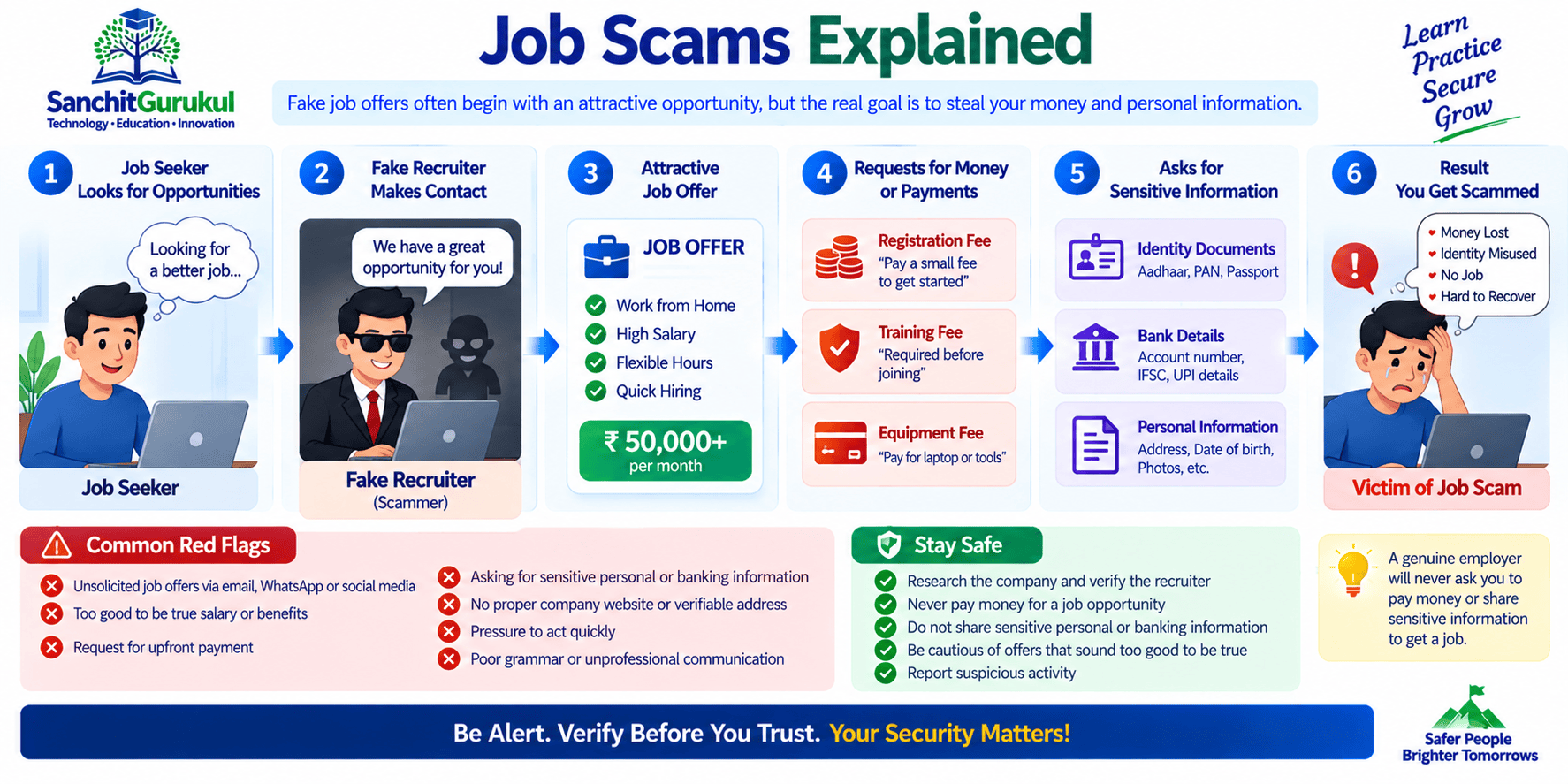
How Job Scams Usually Work
Job scams often follow a predictable process.
Step 1 — Scammer Finds Job Seekers
The fraudster may contact victims through:
- Job portals
- LinkedIn or other professional platforms
- Telegram
- SMS
- Social media
Some fake listings may even appear on otherwise legitimate job platforms. CERT-In specifically warns users to verify job offers carefully even when they appear on trusted platforms.
Step 2 — Attractive Job Is Offered
The position may promise:
High Salary
Work From Home
Immediate Joining
No Experience Required
Flexible Hours
Step 3 — Hiring Happens Unusually Fast
The victim may receive an offer without:
- Proper interview
- Technical assessment
- Background discussion
- Qualification verification
Step 4 — Money Is Requested
The recruiter asks for:
- Registration fee
- Documentation fee
- Training fee
- Security deposit
Step 5 — More Payments Follow
After the first payment:
“Your verification is complete. Pay ₹5,000 security fee.”
Then:
“Pay ₹8,000 laptop deposit.”
Step 6 — No Real Job Exists
Eventually:
- Recruiter disappears
- Phone is switched off
- Website disappears
- Victim is blocked
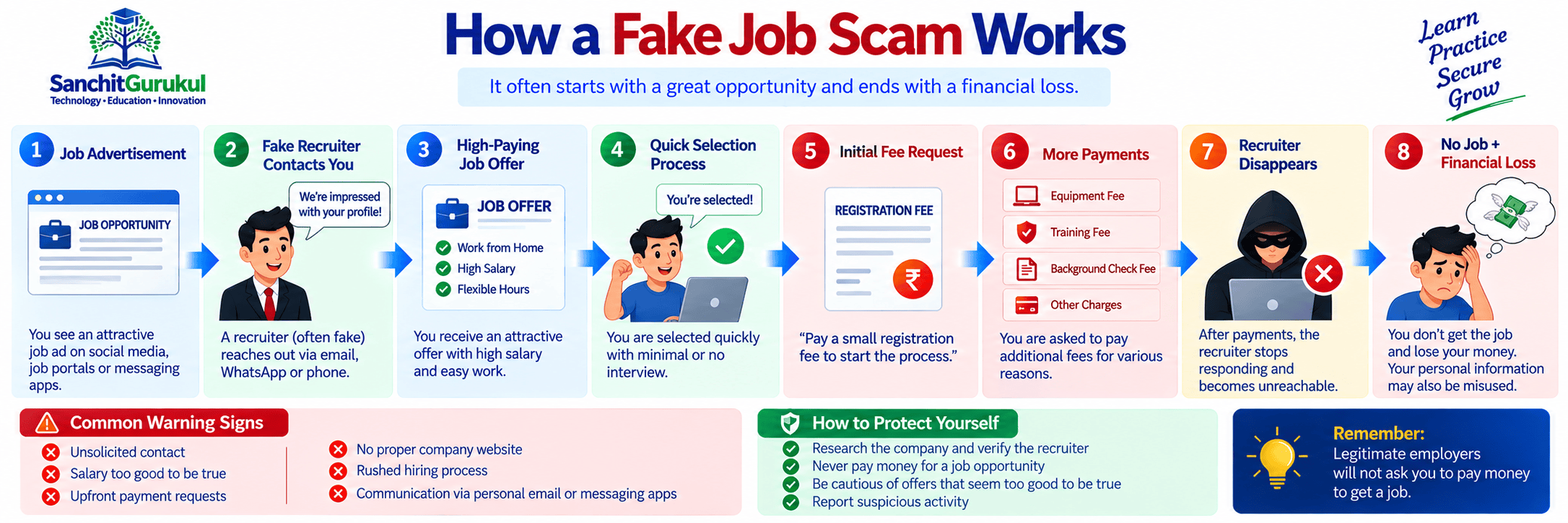
Fake Recruitment Fee Scams
One of the simplest job scams asks candidates to pay before joining.
Example
You receive:
“Congratulations! You have been selected for IT Support Engineer.”
Salary:
₹8,00,000 per year
The recruiter then says:
“Pay ₹3,500 refundable registration fee.”
After payment:
“Background verification requires ₹6,000.”
Then:
“Laptop security deposit ₹12,000.”
Eventually the recruiter disappears.
CERT-In’s guidance is straightforward: genuine employers do not ask candidates for upfront payments or fees as a condition of employment.
Fake Work-From-Home Jobs
Remote work has created legitimate opportunities, but scammers also use the phrase:
“Work From Home”
to attract victims.
Typical offers include:
- Data entry
- Form filling
- Captcha solving
- Product reviews
- Online assistant
- Social-media tasks
- Typing jobs
The advertisement may promise:
“Earn ₹5,000 every day from home.”
The Advance Fee
Before starting, the victim is asked for:
₹1,999 registration
or:
₹5,000 software activation
No meaningful job may exist.
I4C has specifically warned about fake CAPTCHA-filling and part-time jobs that promise high earnings but demand upfront fees or capture personal and financial information.
Task-Based Job Scams
A particularly deceptive variation begins with very simple online tasks.
You may receive:
“Earn ₹100–₹500 per task.”
Tasks might involve:
- Rating businesses
- Liking videos
- Reviewing products
- Following accounts
- Completing simple online activities
Initially, the scammer may actually pay you.
Example
Task 1:
Earn ₹150
Task 2:
Earn ₹200
Task 3:
Earn ₹300
The victim thinks:
“This is genuine. They are actually paying me.”
Then comes:
“Premium task — deposit ₹5,000 and earn ₹7,000.”
Later:
“Deposit ₹20,000 to unlock your earnings.”
The victim starts paying to work.
Why Small Payments Matter
The scammer may deliberately lose a small amount initially to gain your confidence.
Small Payment → Trust → Larger Deposit → Bigger Deposit → Withdrawal Blocked
Fake Job Offers Using Famous Company Names
A scammer may impersonate a well-known organization.
They may copy:
- Company logo
- Careers page
- Recruiter photograph
- Employee name
- Offer-letter format
- Email signature
The job offer may appear to come from a recognizable employer.
Look Beyond the Logo
Suppose the company is:
Example Technologies
but the recruiter writes from:
[exampletechnologies-careers@gmail.com](mailto:exampletechnologies-careers@gmail.com)
instead of an official corporate domain.
That deserves additional verification.
Fake Interview and Offer Letter Scams
A scammer may conduct a fake interview to make the fraud more convincing.
The interview might happen through:
- Phone
- Telegram
- Chat
- Video call
Afterward, the victim receives an official-looking PDF:
Offer Letter
It may contain:
- Company logo
- Candidate name
- Salary
- Joining date
- Employee ID
- HR signature
Then:
“Pay ₹7,500 security deposit to accept the offer.”
Important Point
Creating a professional-looking PDF is easy.
Therefore:
Offer Letter ≠ Proof of Employment
Verify the employer independently.
Job Scams Designed to Steal Personal Data
Not every fake job scam immediately asks for money.
Some are designed to collect information.
A fake recruiter may request:
- Aadhaar
- PAN
- Passport
- Photograph
- Signature
- Address
- Date of birth
- Bank details
- Salary slips
- Resume
Some information may legitimately be needed during a genuine hiring process.
The problem is providing it to an unverified recruiter.
Why Job Seekers Are Attractive Targets
A resume itself can contain valuable information:
Name
Phone
Employment History
Education
Location
This can support future:
- Phishing
- Impersonation
- Identity fraud
- Social engineering
CERT-In advises job seekers not to share personal or banking information with unverified recruiters.
Fake Background Verification Scams
A recruiter may say:
“You have cleared the interview.”
Then:
“Background verification requires ₹3,000.”
A link is provided.
The page asks for:
- Payment
- Aadhaar
- PAN
- Banking details
This may serve two criminal objectives:
Money Theft + Identity Information Theft
Verify Through the Employer
If a legitimate organization requires a background-check process, confirm it through an independently verified HR or recruitment channel.
Equipment and Laptop Deposit Scams
Remote workers may receive:
“We will provide laptop and mobile.”
Then:
“Pay ₹15,000 refundable equipment deposit.”
After payment:
“Courier insurance ₹5,000 required.”
Then another fee appears.
No equipment arrives.
Variation
A fake cheque, reimbursement promise or payment screenshot may also be used to convince the victim that the employer has already sent money.
Fake Overseas Job Scams
International employment offers can be particularly attractive.
The fraudster may promise:
- High salary
- Visa sponsorship
- Free accommodation
- Flight ticket
- Immediate joining
Then they request:
- Visa fee
- Immigration fee
- Medical fee
- Work permit charge
- Travel deposit
Verify Overseas Recruitment Carefully
The Ministry of Home Affairs has noted government advisories concerning Indian nationals lured by fake job rackets abroad and advises job seekers to verify recruiting agents and companies before accepting employment offers.
Fake Government Job Scams
Government employment is another attractive target for fraudsters.
A message may claim:
“Direct recruitment — Government Department.”
or:
“No examination required.”
The criminal may create:
- Fake recruitment website
- Fake appointment letter
- Fake department email
- Fake payment portal
Verify Through Official Government Sources
Do not rely solely on:
- WhatsApp forwards
- Social-media posts
- Telegram channels
- Unknown recruitment websites
Verify vacancies through the relevant department’s official website or recognized government recruitment channel.
Job Scams Through WhatsApp and Telegram
A common message looks like:
“Hello, I am HR Manager from ABC Company.”
“We found your profile online.”
“Part-time work available.”
Then the conversation moves into a private group.
CERT-In identifies unexpected recruiter contact through text or encrypted messaging platforms as one warning sign of fake job proposals.
Why Messaging Apps Are Useful to Scammers
They allow criminals to:
- Contact many people
- Create fake profiles
- Operate groups
- Share payment instructions
- Apply continuous pressure
Money Transfer and Package Handling Jobs
Some fake jobs are more dangerous than simply losing a registration fee.
The victim may be asked to:
“Receive money into your account and transfer it elsewhere.”
or:
“Receive packages and forward them.”
CERT-In lists jobs involving money transfers, purchases or package handling among warning signs associated with fake job proposals.
Why This Is Dangerous
You may unknowingly become involved in suspicious financial or criminal activity.
How Social Engineering Makes Job Scams Work
Job scams exploit powerful emotions.
Hope
“This could change my career.”
Urgency
“Join today or lose the opportunity.”
Authority
“I am the HR manager.”
Excitement
“Your salary will be ₹15 lakh per year.”
Scarcity
“Only two positions remain.”
Financial Pressure
“Just pay ₹5,000 to secure the job.”
The victim begins focusing on:
Getting the Job
instead of:
Verifying the Job
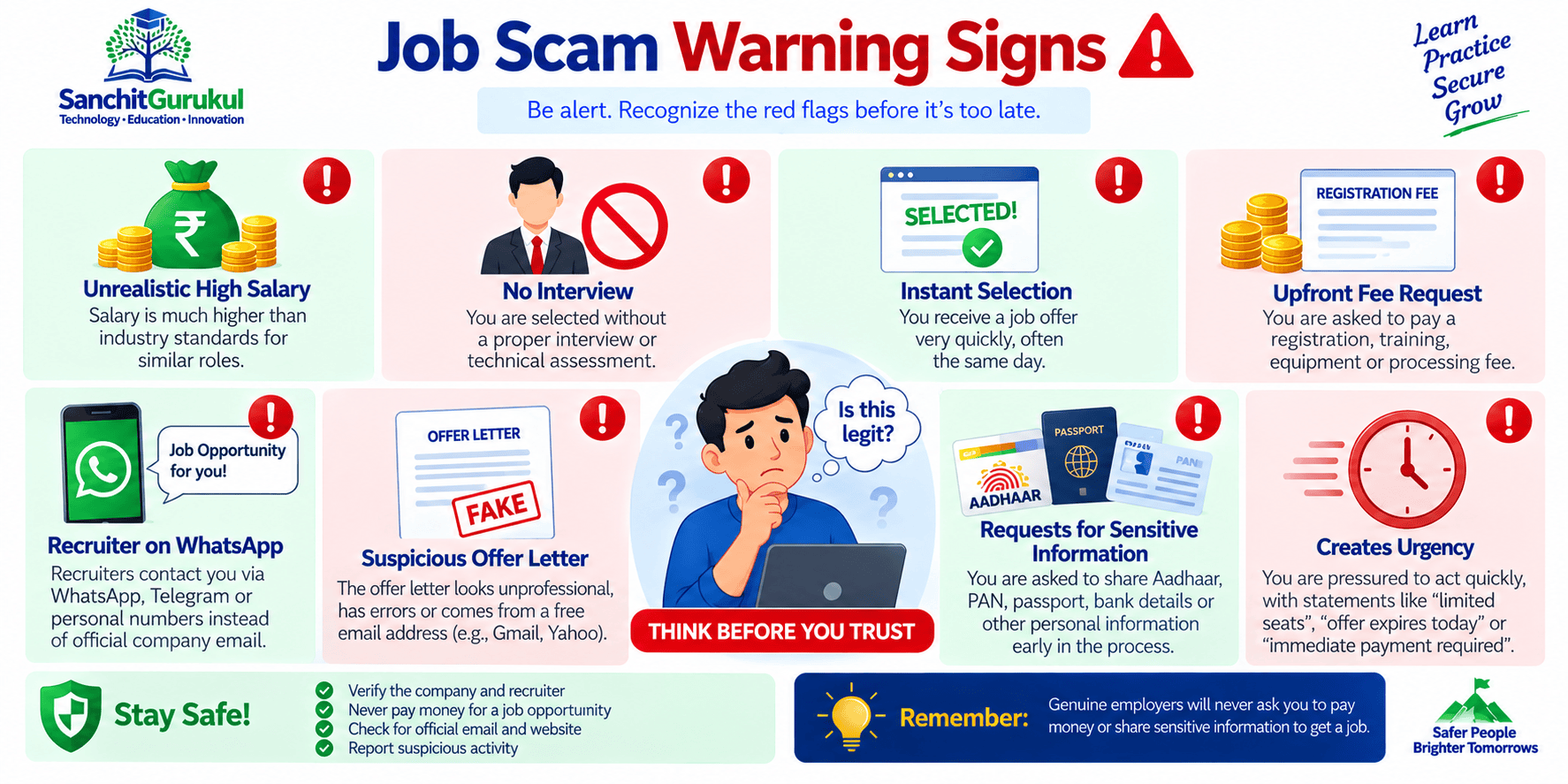
Warning Signs of a Job Scam
Look for combinations of these signs.
Unrealistically High Salary
Especially for simple work requiring little experience.
Immediate Selection
“You are hired.”
without meaningful assessment.
Upfront Payment
Major warning sign.
Personal Email Address
Recruiter claims to represent a large organization but uses an unrelated email account.
Poorly Defined Job
The recruiter cannot clearly explain:
- Role
- Responsibilities
- Manager
- Team
- Work location
Pressure to Act Immediately
“Pay within 30 minutes.”
Sensitive Information Too Early
Requests for identity or banking documents before proper verification.
Communication Only Through Messaging Apps
No verifiable corporate contact.
Payment to Personal Account or UPI ID
Especially for recruitment charges.
Money Transfer or Package Handling
Potentially serious warning sign.
No Verifiable Company Presence
The employer cannot be independently confirmed.
How to Verify a Job Offer
A few checks can prevent many job scams.
Check the Company’s Official Careers Page
Search for the position independently.
Check the Recruiter’s Email Domain
Compare it with the company’s official domain.
Contact the Company Independently
Use contact details from the official website.
Do not use only the phone number supplied by the recruiter.
Search for the Recruiter
Check whether their claimed role and organization can be independently supported.
Examine the Hiring Process
Ask:
Was there a genuine interview?
Were my qualifications discussed?
Can the job responsibilities be explained clearly?
Question Payment Requests
Ask:
Why must I pay money to obtain employment?
Verify Before Sharing Documents
Confirm who is receiving:
- Aadhaar
- PAN
- Passport
- Bank details
Check the Website Carefully
Watch for:
- Misspelled domains
- Recently created-looking sites
- Unusual URLs
- Copied company pages

Job Scam vs Genuine Recruitment
| Genuine Recruitment | Possible Job Scam |
|---|---|
| Defined job responsibilities | Vague work description |
| Proper interview process | Immediate selection |
| Verifiable employer | Difficult to verify |
| Corporate communication | Random messaging account |
| Reasonable salary | Unrealistic income |
| Normal hiring process | Extreme urgency |
| Candidate receives salary | Candidate repeatedly pays recruiter |
No single sign proves fraud.
Look at the complete pattern.
What to Do If You Receive a Suspicious Job Offer
Do Not Pay Immediately
Pause before transferring money.
Do Not Share More Documents
Verify the organization first.
Preserve the Message
Keep:
- SMS
- WhatsApp messages
- Job advertisement
- Recruiter details
- Website address
Verify Independently
Contact the supposed employer through an official channel.
Report Suspicious Cybercrime Indicators
The National Cyber Crime Reporting Portal provides a Report Suspect facility for suspicious:
- Website URLs
- WhatsApp numbers
- Telegram handles
- Phone numbers
- Email IDs
- SMS details
- Social-media URLs
What to Do If You Become a Victim
If you have already paid money or provided sensitive information, act quickly.
If Money Was Transferred
Immediately contact:
- Your bank
- Payment provider
For cyber financial fraud in India:
Call 1930
The National Cyber Crime Reporting Portal identifies 1930 as the helpline for immediate reporting of cyber financial fraud.
Report Online
Use:
If You Shared Identity Documents
Be alert for further:
- Impersonation
- Phishing
- Financial fraud
If You Shared Passwords
Change them immediately.
If the same password was used elsewhere, change those accounts too.
If You Installed an Unknown App
Review:
- App permissions
- Device security
- Banking activity
Remove suspicious software where appropriate.
Preserve Evidence
Keep:
- Job advertisement
- Offer letter
- Emails
- Chat history
- Recruiter phone numbers
- Bank account details
- UPI IDs
- Payment receipts
- Website URLs
- Screenshots
Summary
Job scams exploit something valuable:
A person’s hope of finding employment.
Common job scams include:
- Fake recruitment fees
- Work-from-home scams
- Task-based jobs
- Fake company recruiters
- Fake interviews
- Fake offer letters
- Background-verification scams
- Equipment-deposit scams
- Overseas job scams
- Government-job scams
- Identity-document theft
- Money-transfer jobs
A common pattern is:
ATTRACTIVE JOB → FAST SELECTION → TRUST → FEE OR PERSONAL DATA → MORE DEMANDS → NO JOB
CERT-In recommends verifying job offers and companies before providing personal information and warns that requests for upfront payments and unrealistic earning promises are major red flags.
Useful Links and References
SanchitGurukul Static Resources
Official External References
Your feedback matters
Was this post helpful?
Discussion
0 approved comments
No approved comments yet. You can start the discussion below.
Leave a Comment
No login is required. Name and email are used for moderation/security. Your email is never displayed publicly. All comments require administrator approval.
Discover more from SanchitGurukul
Subscribe to get the latest posts sent to your email.


