
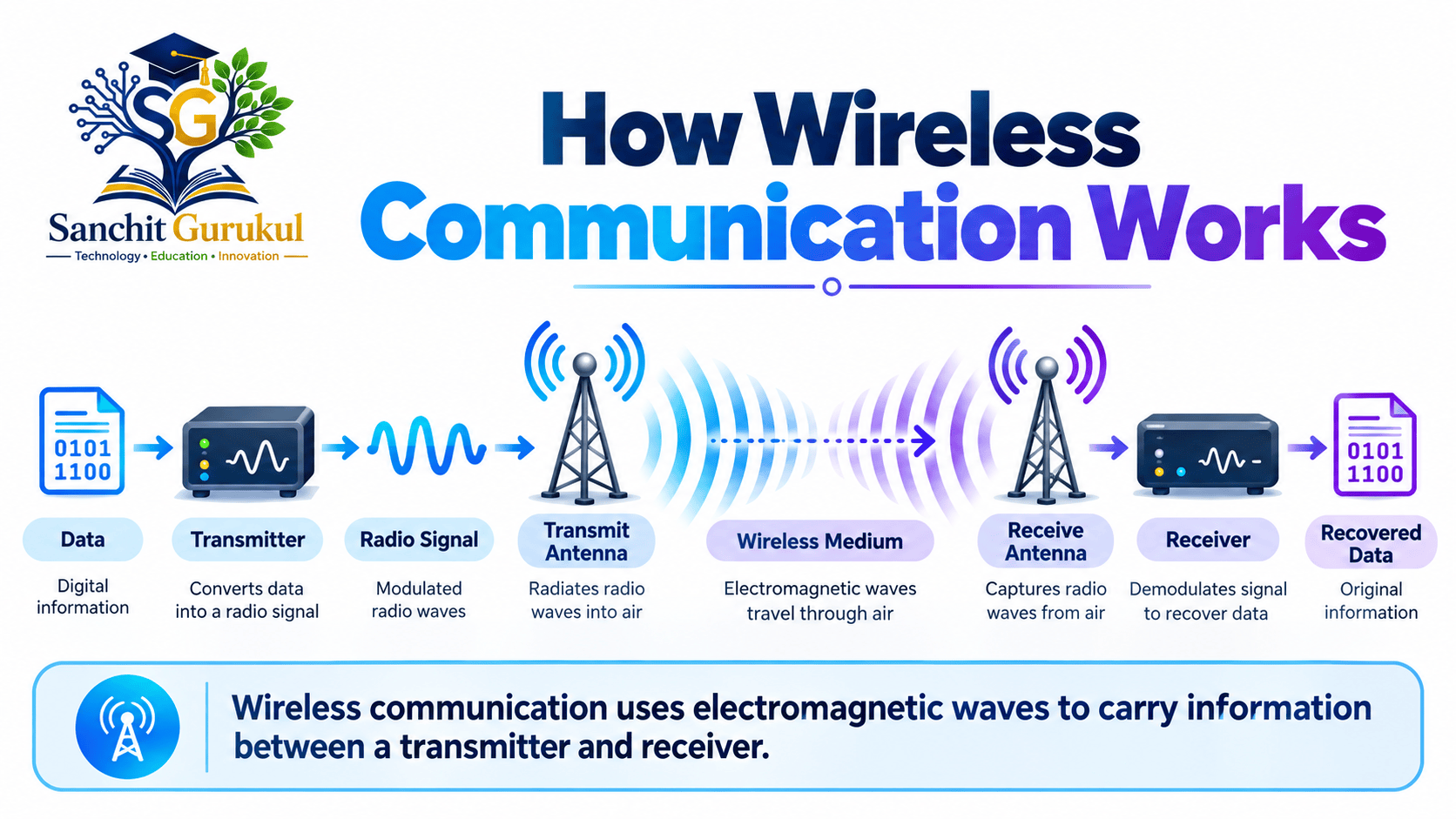
Wireless communication allows information to travel between devices without requiring a physical cable between the transmitter and receiver.
Instead of copper or fiber, wireless systems use:
Electromagnetic waves
to carry information through the surrounding environment.
Wireless communication is used by technologies such as:
- Wi-Fi
- Bluetooth
- Cellular networks
- IoT networks
- Satellite communication
- Radio broadcasting
- Wireless sensors
Although these technologies operate differently, they share several fundamental concepts.
These include:
- Frequency
- Wavelength
- Channels
- Modulation
- Antennas
- Signal propagation
- Signal strength
- Noise
- Interference
- Spectrum management
Electromagnetic Waves, Frequency and Channels
Wireless systems transmit information using electromagnetic energy.
Radio Frequency — RF
The term:
RF — Radio Frequency
is commonly used for wireless signals used in communications.
Examples include:
- Wi-Fi
- Bluetooth
- Cellular
- Radio broadcasting
- Satellite links
Microwave frequencies are also part of the broader radio-frequency spectrum.
Frequency
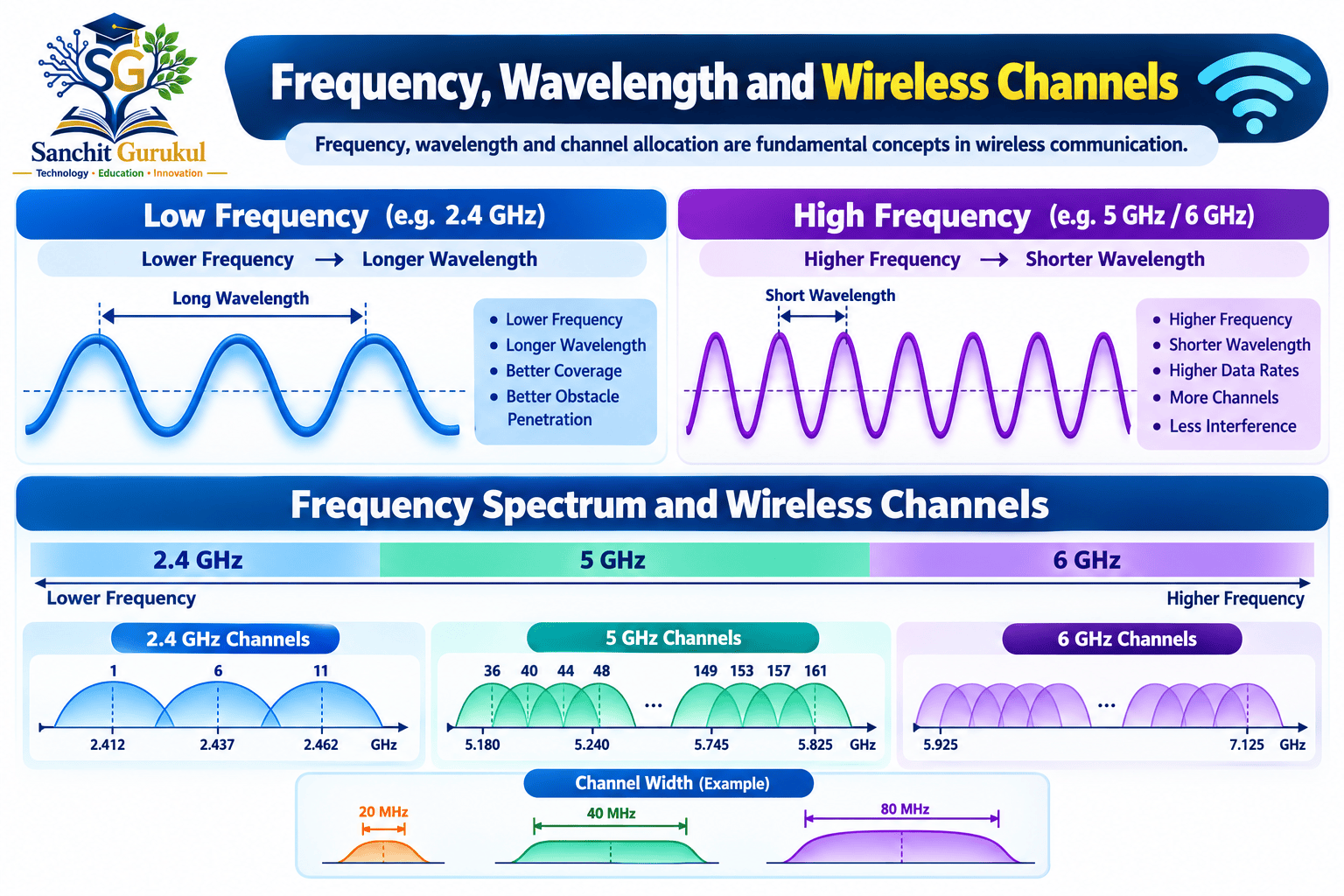
Frequency describes how many times a wave repeats in one second.
It is measured in:
Hertz — Hz
Common units include:
| Unit | Meaning |
|---|---|
| Hz | 1 cycle per second |
| kHz | 1,000 Hz |
| MHz | 1,000,000 Hz |
| GHz | 1,000,000,000 Hz |
For example, Wi-Fi commonly operates in portions of the:
- 2.4 GHz band
- 5 GHz band
- 6 GHz band
depending on the Wi-Fi technology and local regulatory rules.
Wavelength
Wavelength is the physical distance occupied by one complete wave cycle.
Frequency and wavelength are related.
In free space:
Higher Frequency = Shorter Wavelength
and:
Lower Frequency = Longer Wavelength
Frequency and Wavelength
Frequency tells us how quickly the wave repeats.
Wavelength tells us the physical length of the wave.
They are related approximately by:
Wavelength = Speed of Light / Frequency
The relationship is important when designing antennas and understanding radio propagation.
A higher frequency does not automatically mean a shorter usable communication range.
Practical coverage also depends on:
- Transmit power
- Receiver sensitivity
- Antenna characteristics
- Obstacles
- Noise
- Interference
- Channel bandwidth
- Regulatory limits
Wireless Channels
A frequency band can be divided into smaller frequency ranges called:
Channels
Wireless devices use specific channels so that multiple systems can operate within the available spectrum.
Good channel planning is especially important in environments containing many wireless devices.
Modulation and Sharing the Wireless Medium
Digital information cannot simply be placed into the air by itself.
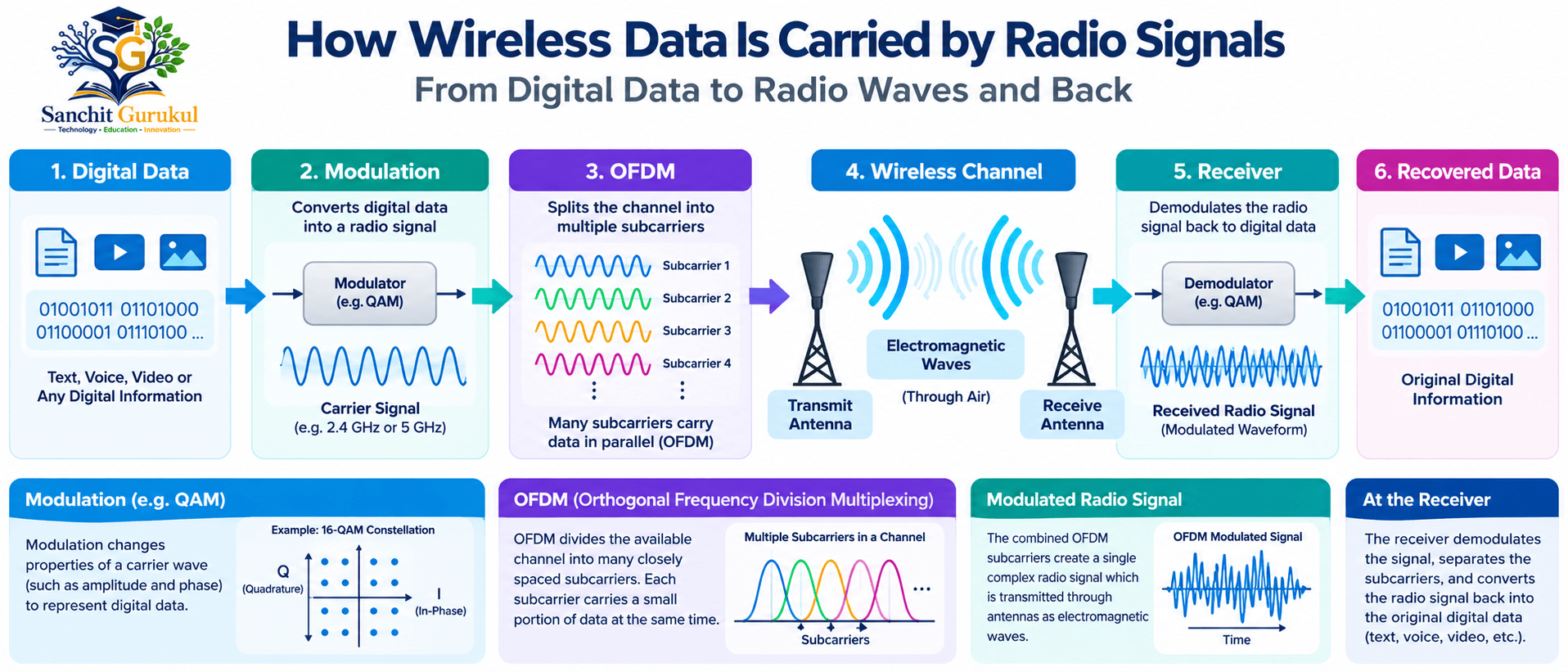
A radio system converts information into changes in a transmitted waveform.
This process is called:
Modulation
What Is Modulation?
Modulation changes characteristics of a carrier signal to represent information.
Those characteristics can include:
- Amplitude
- Frequency
- Phase
Older analog systems provide simple examples.
AM radio changes:
Amplitude
FM radio changes:
Frequency
Modern digital networks use more advanced techniques.
Digital Modulation
Common digital modulation families include:
- PSK — Phase Shift Keying
- QPSK — Quadrature Phase Shift Keying
- QAM — Quadrature Amplitude Modulation
Higher-order modulation can encode more information in each transmitted symbol.
However, it normally requires:
Better signal quality
OFDM
Modern Wi-Fi and many other broadband wireless systems use:
OFDM — Orthogonal Frequency Division Multiplexing
OFDM divides a channel into many closely spaced subcarriers.
Data is distributed across those subcarriers.
Benefits include:
- Efficient spectrum use
- High data rates
- Better handling of multipath conditions
OFDMA
Modern systems such as Wi-Fi 6 use:
OFDMA — Orthogonal Frequency Division Multiple Access
OFDMA allows portions of the available frequency resources to be assigned to different users.
This improves efficiency when many clients need to communicate.
Multiplexing vs Multiple Access
These terms are related but not identical.
| Technique | Basic Purpose |
|---|---|
| FDM | Separate signals by frequency |
| TDM | Separate signals by time |
| OFDM | Divide a broadband channel into orthogonal subcarriers |
| OFDMA | Allocate groups of subcarriers among different users |
| CDMA | Separate users using different codes |
CDMA played an important role in earlier cellular generations.
Modern 4G and 5G systems use different combinations of OFDM-based radio technologies and scheduling mechanisms.
Antennas and Wireless Signal Propagation
Antennas are essential components of wireless systems.
What Does an Antenna Do?
During transmission, an antenna converts electrical RF energy into electromagnetic waves.
During reception, it converts received electromagnetic energy back into an electrical signal that the radio can process.
Common antenna designs include:
- Dipole
- Patch
- Omnidirectional
- Yagi
- Sector
- Parabolic dish
Different antennas are designed for different applications.
Omnidirectional Antennas
An omnidirectional antenna is designed to provide coverage around the antenna.
It is commonly used in:
- Indoor Wi-Fi
- Small wireless devices
- General local coverage
Omnidirectional does not mean the signal travels equally in every possible three-dimensional direction.
The actual radiation pattern depends on the antenna design.
Directional Antennas
Directional antennas concentrate RF energy primarily toward a particular area.
They are useful for:
- Point-to-point wireless links
- Long-distance wireless connections
- Sector coverage
- Satellite communication
Antenna Gain
Antenna gain describes how strongly an antenna concentrates energy in particular directions compared with a reference antenna.
It is commonly expressed in:
dBi
Higher antenna gain does not create energy.
Instead, it changes how available RF energy is distributed.
Signal Propagation
After leaving the antenna, a wireless signal interacts with the surrounding environment.
Important propagation effects include:
- Free-space path loss
- Attenuation
- Reflection
- Diffraction
- Scattering
- Refraction
- Multipath
Attenuation
Attenuation means:
Loss of signal strength
Signal strength normally decreases as distance increases.
Objects can also weaken radio signals.
Examples include:
- Walls
- Floors
- Concrete
- Metal
- Furniture
- Glass
The amount of loss depends on the material, frequency and environment.
Reflection
Radio waves can reflect from surfaces such as:
- Walls
- Buildings
- Metal
- Ground
The reflected signal may reach the receiver using a different path.
Diffraction
A radio wave can bend around the edge of an obstacle.
This behavior can allow some signal to reach areas that do not have perfect line-of-sight.
Scattering
Irregular surfaces or small objects can cause radio energy to spread in multiple directions.
Multipath
One transmitted signal may reach a receiver through several different paths.
Multipath can create fading and distortion.
Modern technologies such as:
- OFDM
- MIMO
- Beamforming
can also make constructive use of complex radio environments.
MIMO
MIMO — Multiple Input Multiple Output
uses multiple transmit and receive antennas.
It can improve:
- Capacity
- Reliability
- Throughput
- Spatial-stream support
Beamforming
Beamforming uses multiple antenna elements and signal processing to shape radio energy more effectively toward a receiver or coverage area.

Signal Strength, Noise and Interference
Wireless communication depends not only on whether a signal is present but also on its quality.
Signal Strength
Received wireless power is commonly expressed in:
dBm — decibels referenced to one milliwatt
Wireless receive levels are commonly negative dBm values.
A value closer to zero represents a stronger received signal.
RSSI
RSSI — Received Signal Strength Indicator
is a measurement or representation of the strength of a received radio signal.
RSSI implementations and scales can differ between technologies and vendors.
It should therefore be interpreted in context.
Noise Floor
Every radio environment contains unwanted energy.
This background level is called the:
Noise Floor
Sources can include:
- Electronic equipment
- Other wireless systems
- Natural RF energy
- Interference
SNR — Signal-to-Noise Ratio
SNR compares the desired signal with background noise.
Understanding SNR
A wireless receiver needs to distinguish the desired transmission from unwanted noise.
Signal: Desired radio transmission
Noise: Unwanted background RF energy
SNR: Difference between useful signal and noise
A higher usable SNR generally allows more reliable communication and potentially higher data rates.
A strong signal combined with high noise may still provide poor performance.
This is why:
Strong RSSI does not automatically mean a good wireless connection.
Interference
Interference occurs when unwanted radio energy affects the desired communication.
Examples include:
- Other Wi-Fi networks
- Bluetooth devices
- Nearby radio systems
- Poor channel planning
- Electronic equipment
- High-density wireless deployments
Co-Channel Contention
Wireless devices using the same channel may need to share access to that channel.
This is particularly important in Wi-Fi networks.
Adjacent-Channel Interference
Poorly selected overlapping channels can interfere with one another.
Correct channel planning is therefore an important part of wireless network design.

Wireless Network Types and Technologies
Wireless technologies are designed for different distances, power levels, capacities and applications.
Common Wireless Network Categories
| Network Type | Typical Purpose | Example Technologies |
|---|---|---|
| WPAN | Personal device connectivity | Bluetooth |
| WLAN | Local network connectivity | Wi-Fi |
| LPWAN | Long-range, low-data-rate IoT | LoRaWAN, NB-IoT |
| WWAN | Regional or nationwide mobile connectivity | 4G LTE, 5G |
| Satellite | Very large or remote-area coverage | GEO, MEO, LEO satellite systems |
WPAN — Wireless Personal Area Network
A WPAN connects devices over relatively short distances.
A common example is:
Bluetooth
Typical applications include:
- Wireless earbuds
- Keyboards
- Mice
- Wearable devices
- Phone accessories
Bluetooth commonly operates in the:
2.4 GHz ISM band
WLAN — Wireless Local Area Network
A WLAN provides wireless connectivity within areas such as:
- Homes
- Offices
- Schools
- Hotels
- Campuses
The dominant WLAN technology is:
Wi-Fi — IEEE 802.11
Modern Wi-Fi can use portions of:
- 2.4 GHz
- 5 GHz
- 6 GHz
depending on the technology and regulatory domain.
LPWAN — Low-Power Wide-Area Network
LPWAN technologies are designed for devices that may require:
- Long battery life
- Small amounts of data
- Wide coverage
Examples include:
- LoRaWAN
- NB-IoT
Typical applications include:
- Sensors
- Smart meters
- Agriculture
- Environmental monitoring
Cellular Networks
Cellular networks provide wide-area mobile communication using:
Base Stations
Modern generations include:
- 4G LTE
- 5G NR
Mobile spectrum varies significantly by:
- Country
- Operator
- Technology
- Regulatory allocation
Modern 5G should not be described as operating only between approximately 700 MHz and 2.6 GHz.
5G uses a much broader collection of frequency ranges, including both lower-frequency spectrum and much higher-frequency bands.
Satellite Communication
Satellite systems can provide connectivity across very large geographical areas.
Satellite networks may use:
- GEO — Geostationary Earth Orbit
- MEO — Medium Earth Orbit
- LEO — Low Earth Orbit
Applications include:
- Remote Internet connectivity
- Television distribution
- Maritime communication
- Aviation communication
- Backhaul
- Emergency communications
Spectrum, Security and Practical Wireless Design
Radio spectrum is a limited shared resource.
Its use must therefore be coordinated.
Spectrum Management
National regulators and international organizations establish rules for radio spectrum.
Spectrum can include:
- Licensed bands
- Unlicensed bands
- Shared-use spectrum
Licensed spectrum is commonly associated with services such as cellular networks.
Unlicensed or licence-exempt spectrum supports technologies such as Wi-Fi and Bluetooth, subject to regional rules.
Wireless Security
Because radio signals can travel beyond a room or building, wireless systems require appropriate security.
Security can include:
- Authentication
- Encryption
- Device identity
- Access control
- Network segmentation
- Monitoring
For Wi-Fi, modern security may include:
- WPA2
- WPA3
- 802.1X
- EAP
- RADIUS
Other wireless technologies use their own authentication and encryption mechanisms.
Example — Home Wi-Fi Communication
Consider a laptop communicating through a home Wi-Fi network.
Client:
Laptop

Wireless Technology:
Wi-Fi

Wireless Infrastructure:
Access Point / Home Router

Radio Band:
2.4 GHz, 5 GHz or 6 GHz depending on device support

Network Access:
Local Network and Internet
The basic process is:
- The laptop discovers the wireless network.
- The laptop authenticates according to the configured security.
- The laptop associates with the access point.
- Data is converted into wireless symbols and transmitted using the supported PHY technology.
- The radio signal propagates through the environment.
- The receiving device processes and demodulates the signal.
- The original network data is recovered.
Modern Wi-Fi uses technologies such as:
- OFDM
- OFDMA in supported generations
- QAM
- MIMO
- Beamforming
to improve efficiency and performance.
Key Takeaways
Core Wireless Principles
- Wireless communication uses electromagnetic waves instead of physical cables.
- Frequency describes how quickly a radio wave repeats.
- Wavelength becomes shorter as frequency increases.
- Wireless spectrum is divided into frequency bands and channels.
Data Transmission
- Modulation allows information to be encoded onto radio signals.
- Modern digital systems use techniques such as PSK and QAM.
- OFDM divides a channel into multiple orthogonal subcarriers.
- OFDMA allows frequency resources to be shared efficiently among multiple users.
Antennas and Propagation
- Antennas transmit and receive electromagnetic energy.
- Signal strength decreases because of distance and attenuation.
- Reflection, diffraction and scattering change how radio signals travel.
- Multipath occurs when several versions of a signal reach the receiver.
- MIMO and beamforming help modern wireless systems use the radio environment efficiently.
Signal Quality
- RSSI represents received signal strength.
- The noise floor represents unwanted background RF energy.
- SNR compares the desired signal with the noise level.
- Strong signal strength alone does not guarantee good wireless performance.
Wireless Technologies
- Bluetooth commonly supports short-range personal connectivity.
- Wi-Fi provides wireless LAN connectivity.
- LPWAN technologies support low-power IoT applications.
- 4G and 5G provide wide-area mobile connectivity.
- Satellite systems provide connectivity across very large or remote areas.
Design and Security
- Wireless spectrum must be carefully managed.
- Frequency and power regulations vary between countries.
- Interference and channel utilization directly affect performance.
- Wireless systems require appropriate authentication and encryption.
- Good wireless design considers capacity and signal quality, not coverage alone.
Wireless communication is much more than simply transmitting a signal through the air.
A successful wireless system depends on the interaction between:
- Spectrum
- Frequency
- Modulation
- Antennas
- Propagation
- Signal strength
- Noise
- Interference
- Channel utilization
- Security
These principles apply across technologies such as:
- Wi-Fi
- Bluetooth
- Cellular
- IoT
- Satellite communication
Understanding these fundamentals makes advanced wireless topics much easier to learn.
Recommended Learning Order
After understanding wireless communication principles, continue with:
- Wi-Fi Fundamentals
- Wi-Fi Frequency Bands
- Wireless Channels
- RSSI and SNR
- MIMO and Beamforming
- OFDM and OFDMA
- Wireless Roaming
- WPA2 and WPA3
- Wireless Troubleshooting
These topics build directly on the RF principles explained in this article.
Useful Links and References
SanchitGurukul Static Resources
Official External References
Your feedback matters
Was this post helpful?
Discussion
0 approved comments
No approved comments yet. You can start the discussion below.
Leave a Comment
No login is required. Name and email are used for moderation/security. Your email is never displayed publicly. All comments require administrator approval.
Discover more from SanchitGurukul
Subscribe to get the latest posts sent to your email.