
Imagine opening a smartphone and speaking a question instead of typing it.
Your phone converts your speech into text and helps you find an answer.
Later, you open a shopping website that recommends products based on your interests.
You then use a translation application to understand a sentence written in another language.
These applications may seem unrelated, but they can all use Artificial Intelligence (AI).
AI is already used in many everyday activities, including online searches, navigation, education, banking, entertainment and cybersecurity.
Some AI systems recognize objects in pictures.
Others translate languages, identify unusual transactions, predict demand or generate new text and images.
But how does AI actually work?
Does it think like a human?
Can it make mistakes?
And how is AI different from ordinary computer software?
In this article, you will learn:
- What Artificial Intelligence means
- How AI differs from ordinary computer programs
- A brief history of AI
- The difference between AI, machine learning and deep learning
- What generative AI is and how it differs from predictive AI
- How AI systems are developed and used
- Everyday applications of AI
- Benefits and limitations of AI
- Why AI can produce incorrect or biased results
- How to use AI responsibly

What Is Artificial Intelligence (AI)?
Artificial Intelligence is a field of computer science focused on developing systems that perform tasks associated with abilities such as recognizing patterns, understanding language, making predictions and solving problems.
An AI system can receive information and produce outputs such as:
- Predictions
- Recommendations
- Decisions
- Written content
- Images
- Speech
- Recognized objects or patterns
AI systems use different methods to produce these results.
Some use machine learning.
Others use rules, search methods, mathematical models or combinations of techniques.
Not every AI system works in the same way.
Does AI Think Like a Human?
Not necessarily.
An AI system may perform a task that humans associate with intelligence without using the same process as a human brain.
For example, an AI image classifier may recognize a dog in a photograph.
However, this does not establish that the system understands the dog in the same way a person does.
Similarly, an AI chatbot can produce useful explanations without guaranteeing that every explanation is accurate.
It is better to describe AI according to what a system can do and how reliably it performs its intended task than to assume it thinks exactly like a person.
AI vs Traditional Computer Programming
Consider a simple example.
A shop wants software that calculates a discount.
A traditional program could follow this rule:
If the purchase amount exceeds ₹5,000, apply a 10% discount.
The developer explicitly defines the condition.
Now imagine the same shop wants to estimate which products customers may buy next month.
A machine-learning system could analyze past sales data and learn patterns that help estimate future demand.
The difference is that the prediction model learns relationships from examples rather than relying only on a developer writing every decision rule.
| Feature | Traditional Rule-Based Program | Machine-Learning-Based AI |
|---|---|---|
| Main Approach | Follows defined rules | Learns patterns from data |
| Example | Calculates a fixed discount | Predicts product demand |
| Behavior | Based on programmed conditions | Based on trained model and inputs |
| Can Make Mistakes | Yes | Yes |
| Needs Human Design | Yes | Yes |
| Can Be Updated | Through code or rules | Through model, data or software updates |
Traditional software and AI are not completely separate categories.
An AI application may contain both ordinary programming and trained models.
A Brief History of AI
Artificial Intelligence is not a completely new idea.
Its modern development began decades before today’s AI chatbots.
| Year | Important Development |
|---|---|
| 1950 | Alan Turing published influential work asking whether machines could demonstrate intelligent behavior |
| 1956 | The Dartmouth research project helped establish AI as a formal field |
| 1980s | Expert systems became an important application of rule-based AI |
| 1997 | IBM Deep Blue defeated world chess champion Garry Kasparov in a match |
| 2012 | Deep learning achieved a major breakthrough in image recognition research |
| 2016 | AlphaGo defeated Lee Sedol in Go |
| 2020s | Generative AI became widely accessible for text, images, audio and other tasks |
AI development has included periods of major progress as well as periods when expectations exceeded practical results.
Why Has AI Become More Useful?
Several developments have contributed to progress:
More Digital Data
Many applications now generate data that can be used to build and evaluate AI systems.
More Computing Power
Modern computing hardware can process large datasets and train increasingly complex models.
Improved Algorithms
Researchers have developed more effective methods for learning patterns and generating outputs.
Better Development Tools
Software libraries and cloud services make AI technologies easier to develop and deploy.
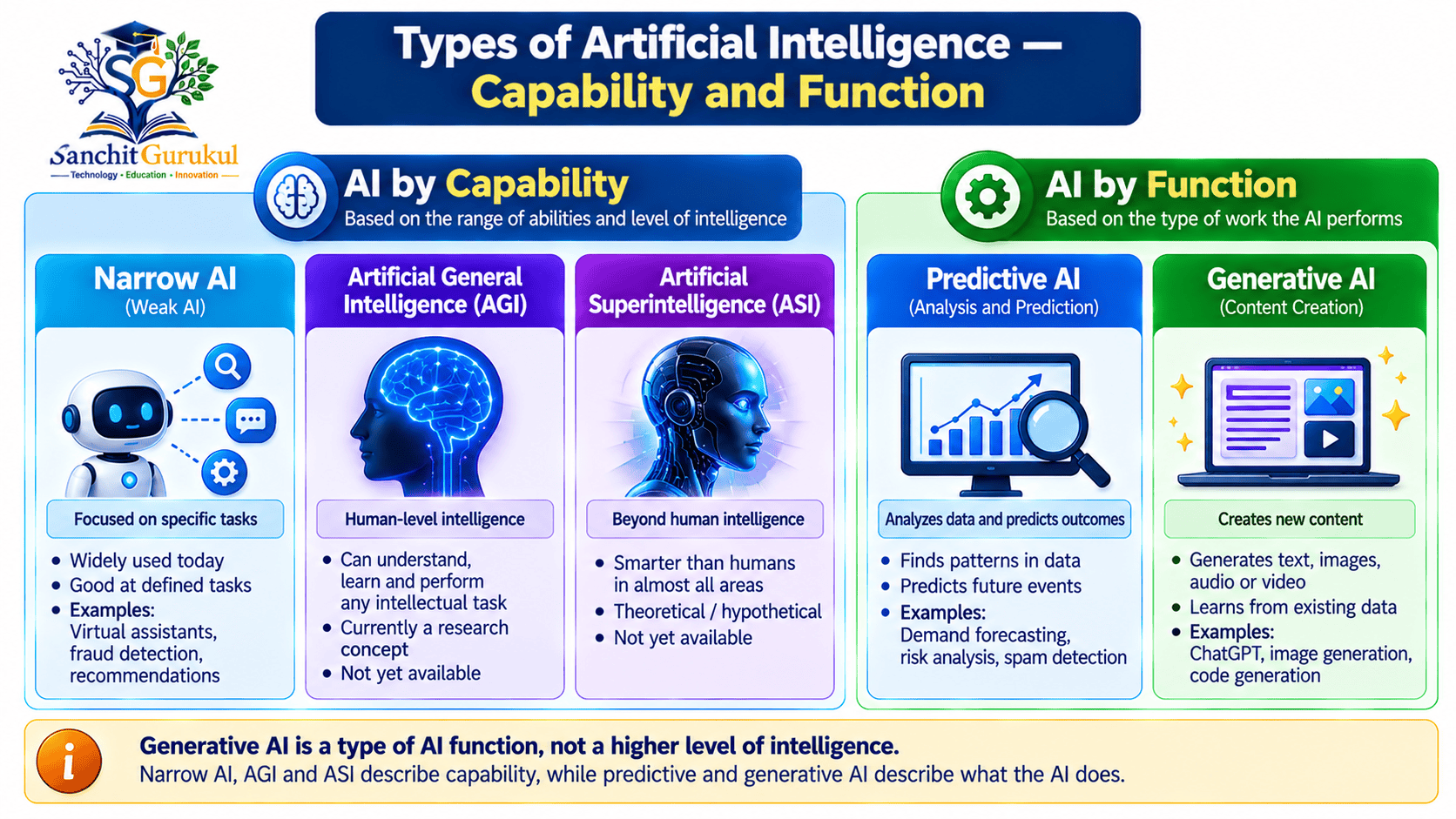
Types of Artificial Intelligence — Narrow AI, General AI and Generative AI
Artificial Intelligence can be divided into categories in different ways.
For beginners, it is useful to understand two separate questions:
What range of tasks can the system perform?
What kind of output does the system produce?
These are different ways of classifying AI.
1. Narrow AI
Narrow AI refers to AI designed for particular tasks or sets of tasks.
Examples include:
- Spam detection
- Speech recognition
- Product recommendations
- Image recognition
- Fraud detection
- Language translation
A narrow AI system may perform very well within its supported tasks while being unable to perform unrelated tasks reliably.
Many deployed AI systems fall within this broad category.
2. Artificial General Intelligence (AGI)
Artificial General Intelligence describes a proposed form of AI with broad abilities across many kinds of intellectual tasks.
Researchers do not have a universally accepted definition or test for establishing AGI.
It remains an area of research and debate.
A system that can answer questions on many subjects does not automatically meet an agreed standard for AGI.
3. Artificial Superintelligence (ASI)
Artificial superintelligence refers to a hypothetical AI system that would exceed human abilities across a very broad range of intellectual activities.
This is a theoretical concept, not a verified capability category of ordinary deployed AI systems.
AI Capability Categories
| Type | Simple Meaning | Status |
|---|---|---|
| Narrow AI | Performs supported tasks within particular areas | Widely deployed |
| AGI | Proposed broad, general-purpose intellectual capability | Research concept; no universally agreed verification |
| ASI | Hypothetical intelligence beyond human intellectual capabilities | Theoretical |
4. What Is Generative AI?
Generative AI is AI designed to produce new content based on the patterns learned during its development.
Depending on the system, this content may include:
- Text
- Images
- Audio
- Video
- Code
- Other forms of data
For example, a generative AI application may draft an email from a user’s instructions.
Another system may create an image from a written description.
Generative AI is not a fourth level after narrow AI, AGI and ASI.
It is a category based on the system’s function.
Predictive AI vs Generative AI
Predictive AI
Uses information to estimate an outcome, identify a category or make a prediction.
Generative AI
Creates content based on learned patterns and input instructions.
| Example | AI Function |
|---|---|
| Identifying a suspicious payment | Classification or prediction |
| Predicting tomorrow’s sales | Forecasting |
| Detecting an object in an image | Recognition |
| Writing a story | Generation |
| Creating an illustration | Generation |
| Producing a voice narration | Generation |
Some applications combine predictive and generative functions.
AI, Machine Learning, Deep Learning and NLP Explained
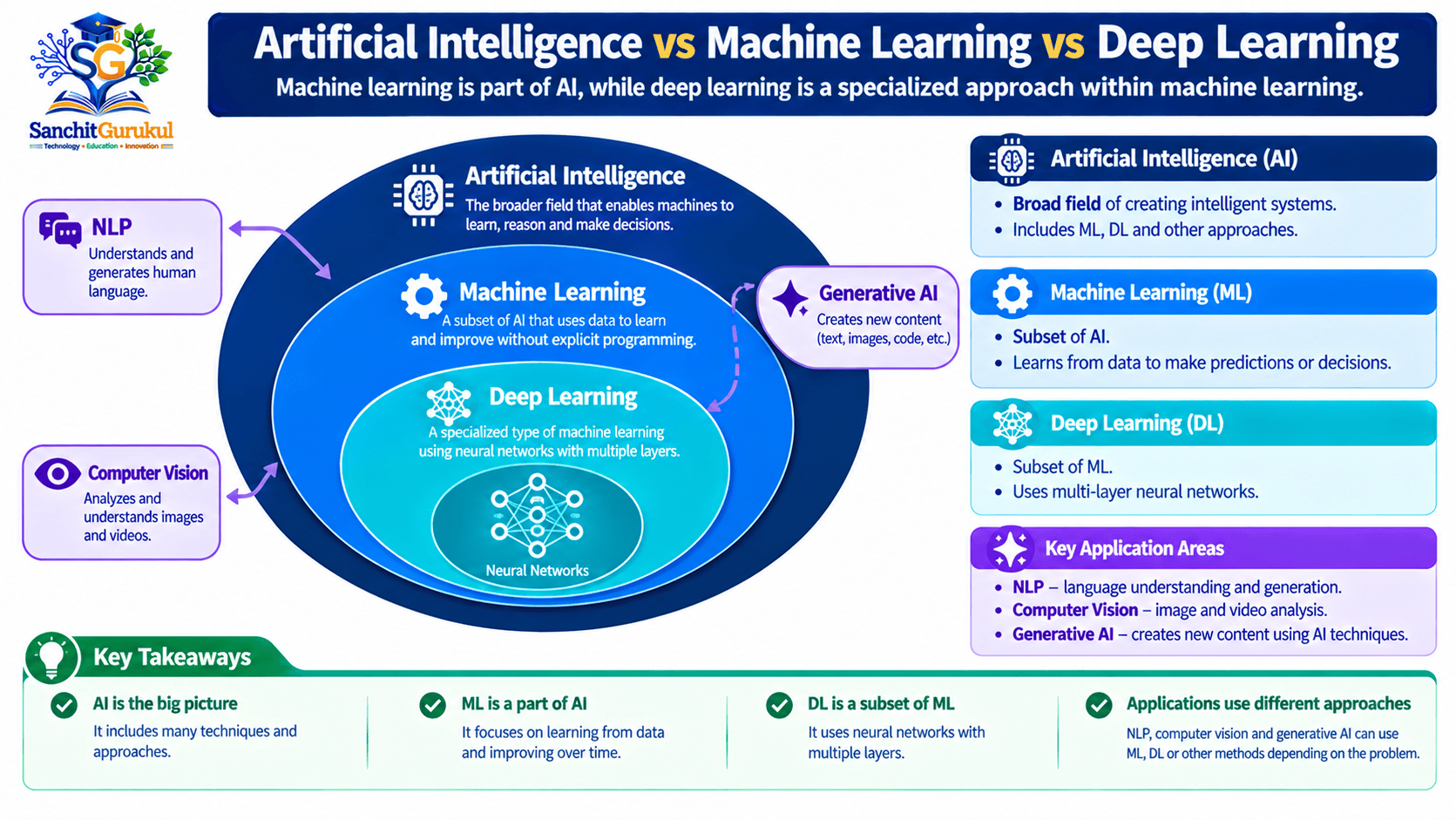
Several technologies are closely related to AI.
Understanding their relationships makes AI easier to learn.
1. Artificial Intelligence (AI)
AI is the broad field.
It includes approaches used to build systems that can perform tasks requiring capabilities such as pattern recognition, planning, language processing and prediction.
2. Machine Learning (ML)
Machine Learning is an approach within AI in which a model learns patterns from data.
A model is the mathematical or computational structure used to produce results.
For example, a model can be trained using historical sales information to estimate future demand.
Machine learning includes several approaches.
Supervised Learning
The model learns from examples containing expected answers or labels.
Example: Pictures labeled as cats or dogs.
Unsupervised Learning
The model looks for patterns or structure in data without relying on the same kind of predefined answer labels.
Example: Grouping customers with similar purchasing behavior.
Reinforcement Learning
A learning system improves its behavior through feedback associated with actions and outcomes.
Example: Training an agent to perform tasks in a simulation.
3. Deep Learning
Deep Learning is a part of machine learning.
It uses neural networks containing multiple processing layers.
A neural network is a mathematical system made up of connected computational units.
Deep learning is used in applications such as:
- Speech recognition
- Image recognition
- Language processing
- Generative AI
- Some scientific applications
Deep learning can be powerful, but it may require substantial computing resources and suitable training data.
4. Natural Language Processing (NLP)
Natural Language Processing concerns computers working with human language.
Examples include:
- Language translation
- Speech-to-text systems
- Text classification
- Search and question answering
- AI chatbots
NLP can use machine learning, deep learning and other approaches.
5. Computer Vision
Computer Vision involves analyzing and interpreting images or video.
Examples include:
- Detecting objects in photographs
- Checking manufactured products for visible defects
- Identifying road signs
- Supporting medical image analysis
6. Robotics
Robotics involves designing and operating machines that interact with the physical world.
Some robots use AI for:
- Recognizing objects
- Planning movements
- Navigating environments
- Adapting to changing conditions
However, not every robot uses AI.
A robot that repeats a fixed sequence may operate entirely through conventional programming.
Relationship Between AI, ML and Deep Learning
| Technology | Simple Explanation |
|---|---|
| AI | Broad field of intelligent computer systems |
| Machine Learning | Models learn patterns from data |
| Deep Learning | ML using multi-layer neural networks |
| NLP | Working with human language |
| Computer Vision | Analyzing images and video |
| Robotics | Building machines that act in the physical world |
| Generative AI | Producing content such as text, images or audio |
How Artificial Intelligence Works — From Data to Results
Not every AI system follows the same development process.
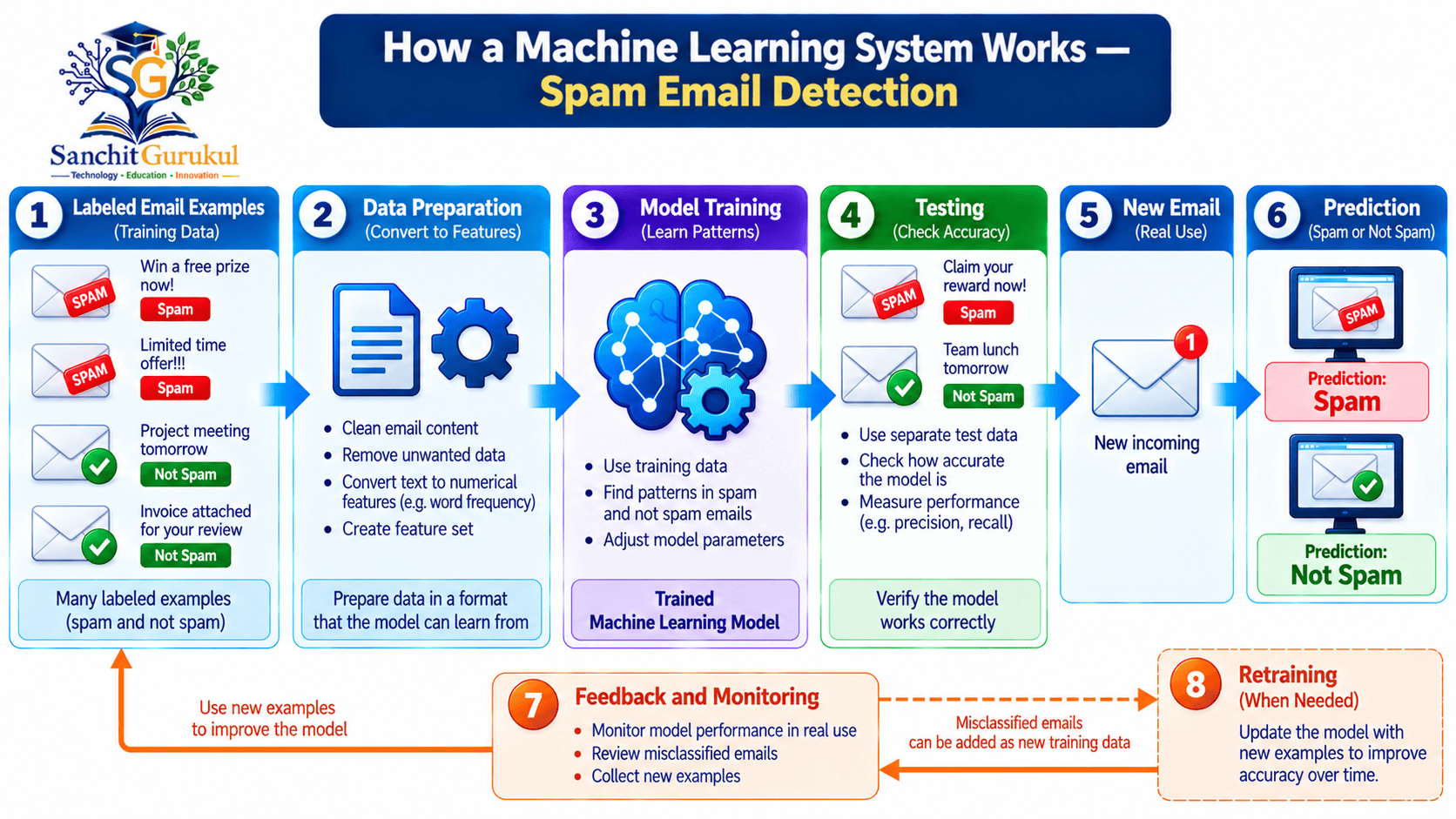
However, many machine-learning applications use a similar sequence of steps.
Consider a simple example: developing an AI system that identifies spam emails.
Step 1 — Define the Problem
First, developers decide what the system should do.
In this example, the task is to identify whether an email is likely to be spam.
The intended output might be:
- Spam
- Not spam
Step 2 — Collect Suitable Data
The system needs relevant examples for learning and evaluation.
Developers may use a dataset of emails that have been appropriately classified.
The dataset should be obtained and handled lawfully, with attention to privacy and security.
Step 3 — Prepare the Data
Collected data may contain errors, missing information or unsuitable examples.
Developers prepare the data so it can be used effectively.
For example, they may remove duplicates and check the quality of the labels.
Step 4 — Train the Model
During training, a machine-learning algorithm adjusts the model using the training examples.
The goal is to learn patterns useful for distinguishing spam from legitimate email.
Training does not mean the model memorizes every example perfectly.
Step 5 — Test the Model
The trained model is evaluated using suitable data that was not used to teach it the same examples.
This helps determine how well it performs on previously unseen inputs.
Developers may evaluate:
- Correct predictions
- Incorrect predictions
- Missed spam messages
- Legitimate messages incorrectly classified as spam
Step 6 — Deploy the Model
Once the model meets the intended requirements, it can be integrated into an application.
For example, an email service may use the model to help classify incoming messages.
Step 7 — Monitor Performance
After deployment, developers monitor the system.
Spam patterns change over time.
A model that performs well today may become less effective as new types of messages appear.
The organization may need to update the data, model or supporting software.
However, this does not mean every AI model automatically learns from each new email while running.
Some models remain unchanged until explicitly retrained or updated.
Simple AI Learning Example
Where Artificial Intelligence Is Used in Everyday Life
AI can support many types of work, but its benefits and limitations depend on the specific application.
1. Education
AI can help students and teachers with:
- Explaining difficult concepts
- Language practice
- Personalized learning activities
- Creating practice questions
- Reviewing written work
- Improving accessibility
For example, an educational assistant may explain a networking topic using simpler language.
However, students should verify important information rather than assuming every explanation is correct.
2. Healthcare
AI can support medical professionals by helping analyze images, identify patterns and organize relevant information.
For example, an AI-based system may highlight suspicious findings in a medical image.
However, such tools require appropriate clinical validation and professional oversight.
AI-generated medical conclusions should not be treated as a substitute for qualified medical judgment.
3. Banking and Finance
Financial institutions use AI-related methods for tasks such as:
- Fraud detection
- Transaction monitoring
- Risk analysis
- Customer support
- Document processing
For example, a system may flag an unusual payment for additional verification.
The alert does not automatically prove that fraud occurred.
4. Retail and E-Commerce
Online stores may use AI to:
- Recommend products
- Forecast demand
- Improve search results
- Assist customer service
- Analyze purchasing patterns
A recommendation system might suggest products based on previous interactions.
However, users should have appropriate privacy protections and control over how personal information is used.
5. Transportation
AI is used in different transportation applications.
Examples include:
- Traffic prediction
- Route recommendations
- Driver assistance
- Vehicle perception
- Fleet maintenance analysis
Driver-assistance software should not automatically be described as a fully autonomous driving system.
Its capabilities and required human supervision depend on the system.
6. Manufacturing and Agriculture
Factories can use AI-assisted image analysis to identify visible defects in products.
Agricultural applications may use image data and other measurements to monitor crop conditions.
These systems can support decision-making, but their results depend on suitable data and operating conditions.
7. Cybersecurity
AI-related techniques can support:
- Spam identification
- Suspicious login detection
- Malware-related classification
- Network behavior analysis
- Security alert prioritization
For example, a security system may identify unusual login behavior and request additional verification.
AI does not guarantee that every threat will be detected.
8. Accessibility and Communication
AI-powered technologies can assist people through:
- Speech-to-text transcription
- Text-to-speech
- Translation
- Image descriptions
- Communication support
The accuracy and usefulness of these tools differ across languages, environments and individual needs.
Common AI Applications at a Glance
| Area | Everyday Example | Possible Benefit |
|---|---|---|
| Education | AI study assistant | Personalized explanations |
| Healthcare | Medical image analysis | Decision support |
| Finance | Suspicious transaction detection | Faster review |
| Shopping | Product recommendations | Easier discovery |
| Transportation | Route prediction | Better planning |
| Manufacturing | Defect detection | Quality inspection support |
| Cybersecurity | Suspicious activity analysis | Faster investigation |
| Accessibility | Speech-to-text | Improved access to information |

Benefits, Limitations and Responsible Use of Artificial Intelligence
AI can be useful, but its performance and reliability vary widely.
A responsible approach considers both its benefits and its risks.
Important Benefits of AI
1. Saving Time
AI can assist with repetitive work such as sorting information, summarizing documents or classifying records.
2. Analyzing Large Amounts of Data
AI systems can identify patterns in datasets that would be difficult to review manually.
3. Supporting Decisions
AI can provide predictions or recommendations that help people review options.
4. Personalizing Services
Applications can adjust content or recommendations based on relevant user needs and preferences.
5. Improving Accessibility
Speech recognition, translation and related tools can improve access to digital information.
6. Supporting Scientific and Technical Work
AI can help researchers analyze data and explore potential solutions.
These are possible benefits, not guaranteed outcomes for every system.
Important Limitations and Risks
1. Incorrect Results
AI systems can produce wrong answers or predictions.
Generative AI may create convincing but false explanations, references or details.
This is commonly called an AI hallucination.
2. Bias and Unfair Outcomes
A system trained on incomplete or unrepresentative data may perform differently for different groups or situations.
Bias can also arise through design decisions and deployment practices.
3. Privacy Risks
AI applications may process personal, confidential or commercially sensitive information.
Sharing such information without appropriate safeguards can create privacy or security risks.
4. Security Risks
Attackers may attempt to manipulate AI systems through malicious inputs or exploit weaknesses in connected applications.
5. Limited Understanding of Context
An AI system may miss important circumstances, misunderstand instructions or generate answers that are inappropriate for the situation.
6. Cost and Resource Requirements
Developing and operating some AI models can require substantial computing resources, energy and specialist expertise.
7. Effects on Employment
AI can automate particular tasks and change how work is performed.
It may create new opportunities while also changing or reducing demand for some existing roles.
The effects depend on the industry, technology and how organizations adopt it.
Advantages and Limitations Comparison
| Potential Advantage | Important Limitation |
|---|---|
| Faster information processing | May produce incorrect results |
| Repetitive-task assistance | Requires suitable controls |
| Data-driven predictions | Predictions can be inaccurate |
| Personalized experiences | Raises privacy considerations |
| Language and accessibility support | Quality varies across users and languages |
| Automation of selected tasks | Can affect employment and workflows |
| Content generation | Can create misleading material |
| Support for decision-making | Human judgment may remain essential |
What Is Responsible AI?
Responsible AI means designing, developing and using AI systems with appropriate attention to safety, reliability, fairness, privacy and accountability.
Useful principles include:
- Accuracy: Test whether the system performs its intended task correctly.
- Fairness: Check for unsuitable differences in performance or outcomes.
- Privacy: Protect personal and sensitive information.
- Security: Reduce misuse and unauthorized access.
- Transparency: Explain AI involvement and important limitations where appropriate.
- Human Oversight: Ensure people can review or intervene in consequential decisions.
- Monitoring: Check how the system performs after deployment.
The NIST AI Risk Management Framework provides guidance for identifying and managing AI-related risks.
How to Use AI Safely as a Student or Everyday User
Before relying on an AI-generated answer:
- Check important facts against reliable sources.
- Avoid sharing passwords, OTPs, private keys or confidential records.
- Verify technical commands before using them on real systems.
- Be careful with generated images, impersonation and misleading content.
- Ask for explanations when a result is unclear.
- Use qualified professionals for high-stakes decisions.
Key Takeaways
Core AI Concepts
- Artificial Intelligence is a broad field of computer science.
- AI systems can produce predictions, recommendations, decisions or content.
- AI does not necessarily think or learn in the same way humans do.
- Narrow AI is widely used in practical applications.
- AGI and artificial superintelligence remain research or theoretical concepts.
How AI Works
- Machine learning uses data to learn useful patterns.
- Deep learning is an approach within machine learning.
- NLP focuses on language-related tasks.
- Computer vision focuses on images and video.
- Generative AI creates content such as text, images and audio.
- Not every AI model updates itself continuously after deployment.
Everyday Applications
- AI supports education, healthcare, finance and shopping.
- Navigation systems may use AI-related prediction techniques.
- Cybersecurity applications can use AI to identify suspicious patterns.
- Accessibility tools can use AI for transcription and translation.
- AI can help people make decisions, but it may also make mistakes.
Benefits and Responsible Use
- AI can save time and support repetitive tasks.
- AI can analyze large datasets and identify patterns.
- Generated outputs may be inaccurate.
- Privacy, security and fairness require attention.
- Human oversight remains important.
- Important results should be verified before use.
Artificial Intelligence is becoming part of everyday technology.
From language translation and navigation to education, healthcare and cybersecurity, AI systems can help people process information, recognize patterns and perform useful tasks.
Machine learning and deep learning are important approaches used in modern AI, while generative AI enables the creation of text, images, audio and other content.
However, AI is not a replacement for human understanding and responsibility.
Its performance depends on its design, data, evaluation and operating environment.
AI systems can make mistakes, produce biased results or generate misleading information.
For students and beginners, the best starting point is to understand what AI can do, how it is developed and where its limitations lie.
Learning these fundamentals makes more advanced AI topics easier to understand.
Next in This Series: Machine Learning Explained — How Computers Learn from Data, Training, Testing and Real-World Examples.
Useful Links and References
SanchitGurukul Static Resources
Official External References
Your feedback matters
Was this post helpful?
Discussion
0 approved comments
No approved comments yet. You can start the discussion below.
Leave a Comment
No login is required. Name and email are used for moderation/security. Your email is never displayed publicly. All comments require administrator approval.
Discover more from SanchitGurukul
Subscribe to get the latest posts sent to your email.

