
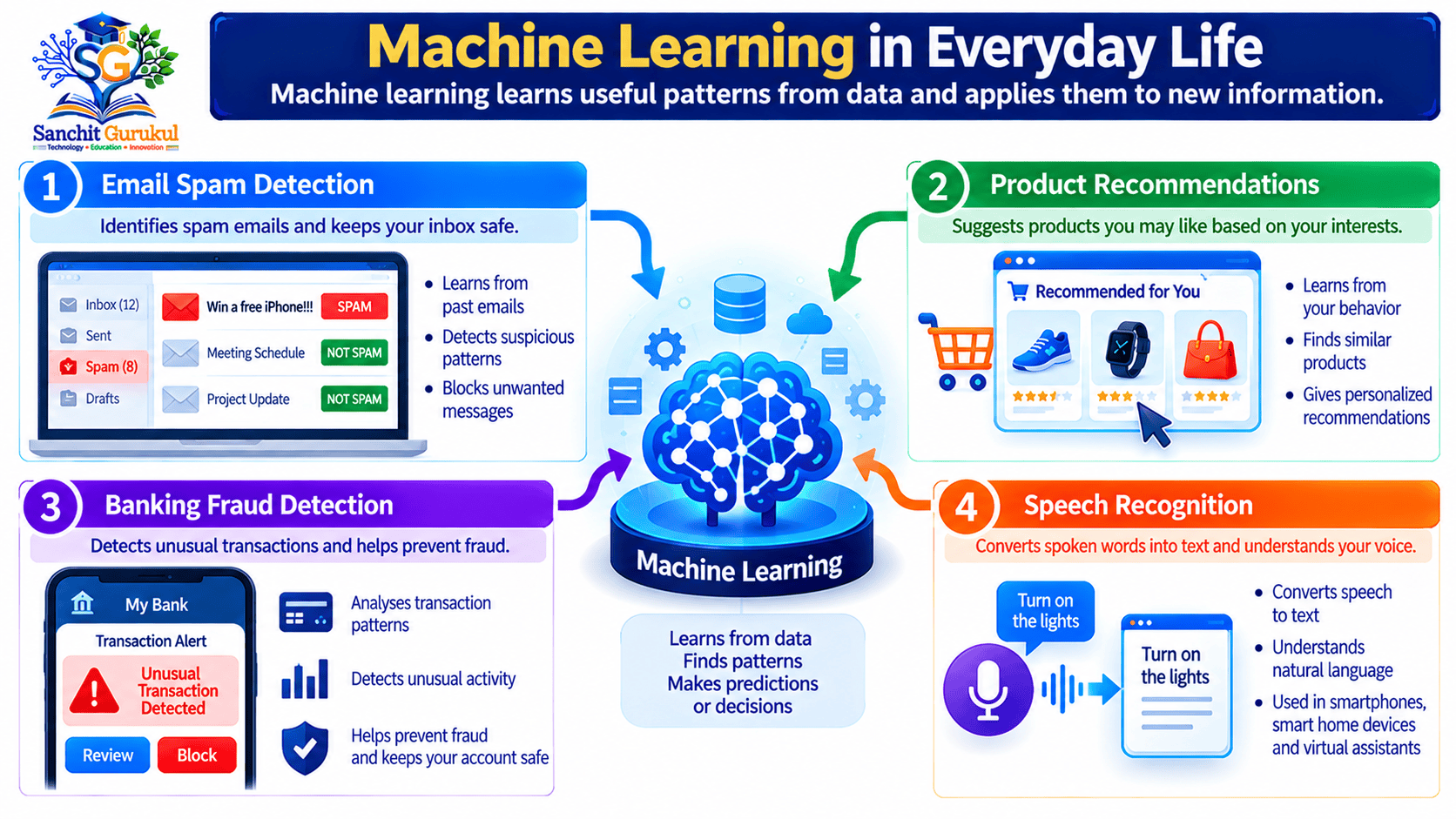
Imagine using an email service that automatically moves suspicious messages into a spam folder.
You receive an email offering an unrealistic prize.
The email service identifies it as possible spam.
But how does the system know that the message might be suspicious?
Does a programmer manually write a rule for every possible spam message?
Not necessarily.
Many spam filters use Machine Learning (ML) to recognize patterns from examples of legitimate and unwanted emails.
The system learns useful relationships from data and uses them to evaluate new messages.
Machine learning is also used in recommendation systems, speech recognition, banking, cybersecurity and many other applications.
However, computers do not necessarily learn in the same way humans do.
A machine-learning system uses mathematical methods and data to develop a model that can make predictions or identify patterns.
In this article, you will learn:
- What machine learning means
- How machine learning differs from traditional programming
- How a machine-learning model is trained
- Types of machine learning
- What classification, regression and clustering mean
- The difference between training, validation and testing
- What overfitting and underfitting are
- Where machine learning is used in everyday life
- Benefits, limitations and responsible use
What Is Machine Learning and How Is It Different from Traditional Programming?
Machine Learning is a field within Artificial Intelligence that develops systems capable of learning patterns from data.
These patterns can be used to:
- Make predictions
- Classify information
- Identify similarities
- Detect unusual activity
- Recommend suitable options
- Support decision-making
A machine-learning system does not need a programmer to explicitly define every possible pattern it may encounter.
However, humans still design the system, select training methods, prepare data and decide how the results should be used.
Traditional Programming vs Machine Learning
Consider an online shop.
The shop wants to offer a discount when a customer spends more than ₹5,000.
A traditional program could use a fixed rule:
Now imagine the shop wants to estimate which products may sell well next month.
Writing fixed rules for every possible customer behavior would be difficult.
A machine-learning model could analyze historical sales information and learn relationships useful for predicting future demand.
Traditional Programming vs Machine Learning
| Feature | Traditional Programming | Machine Learning |
|---|---|---|
| Main Approach | Follows programmed rules | Learns patterns from data |
| Example | Calculates a discount | Predicts product demand |
| Rules | Explicitly defined | Relationships learned during training |
| Development | Code and logic | Data, model and supporting code |
| Can Make Errors | Yes | Yes |
| Needs Human Oversight | Yes | Yes |
These approaches often work together.
A machine-learning application still contains ordinary software that collects data, processes inputs, runs the model and handles results.
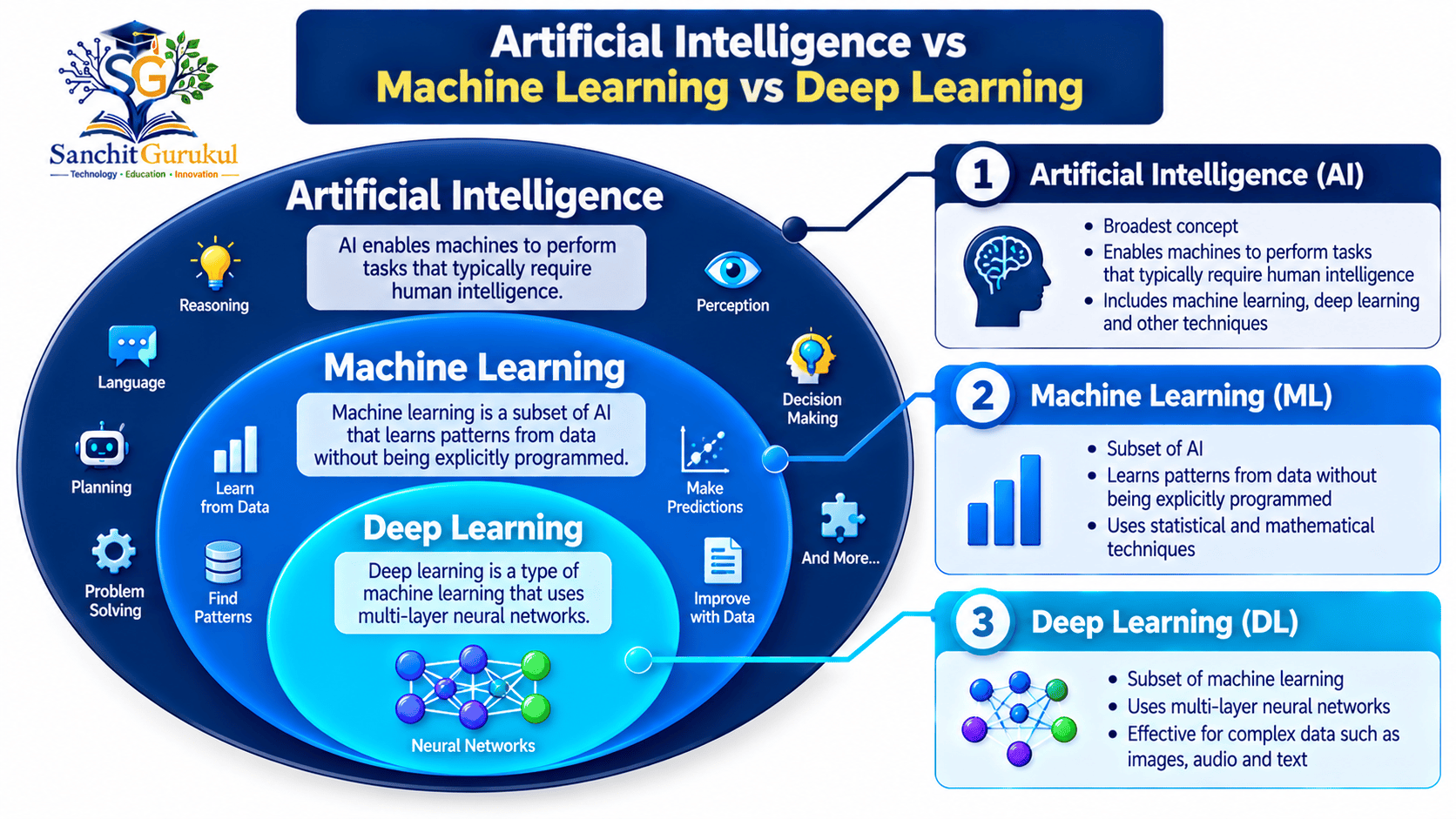
AI vs Machine Learning vs Deep Learning
The three terms are related but do not mean the same thing.
Artificial Intelligence (AI)
The broad field of developing systems that perform tasks involving capabilities such as recognition, prediction and problem-solving.
Machine Learning (ML)
An approach within AI in which models learn patterns from data.
Deep Learning (DL)
A branch of machine learning that uses neural networks containing multiple processing layers.
Relationship Between AI, ML and Deep Learning
| Technology | Simple Meaning |
|---|---|
| AI | Broad field of intelligent computer systems |
| Machine Learning | AI approach that learns patterns from data |
| Deep Learning | Machine learning using multi-layer neural networks |
How Machine Learning Works — Data, Training, Validation and Testing
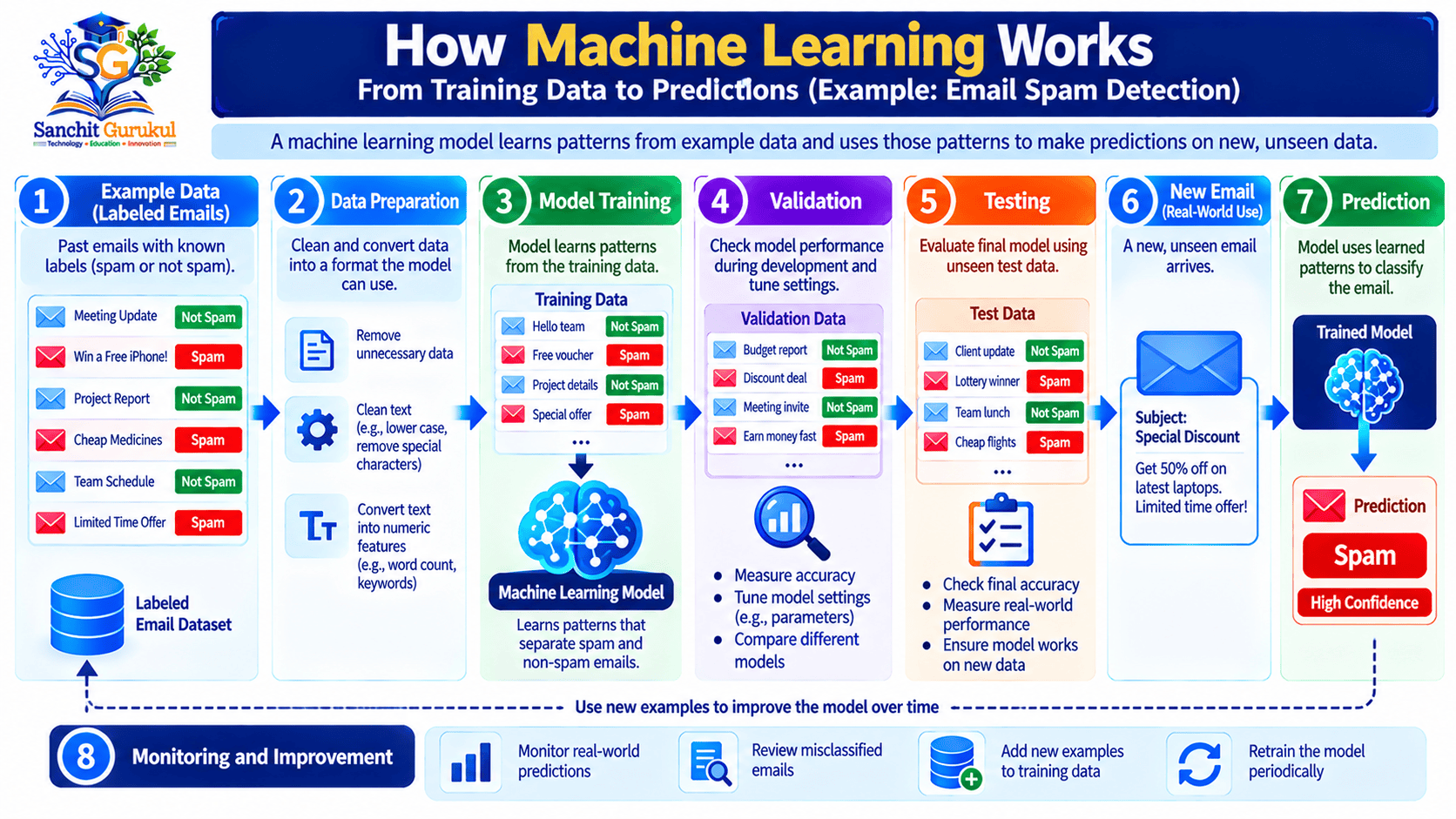
Most machine-learning projects follow a series of development steps.
The exact process varies depending on the problem, but the basic ideas are similar.
Consider an email spam detector.
Step 1 — Define the Problem
The first step is identifying what the system should do.
For example:
“Determine whether an incoming email is spam or legitimate.”
The expected output contains two possible categories:
- Spam
- Not Spam
Step 2 — Collect Data
Developers collect relevant examples.
For a spam detector, the examples may include legitimate and unwanted email messages.
In supervised learning, these examples include the expected classifications.
Training data should be obtained and handled with appropriate privacy and security safeguards.
Step 3 — Prepare the Data
Raw information may contain mistakes or unsuitable entries.
Data preparation can involve:
- Removing duplicates where appropriate
- Correcting errors
- Handling missing information
- Checking labels
- Organizing data into a usable format
For some tasks, developers also select or transform useful input characteristics.
These characteristics are called features.
For example, features might describe properties of an email message that help a model classify it.
Step 4 — Train the Model
During training, a machine-learning algorithm uses examples to adjust the model.
The model learns mathematical relationships that may help solve the task.
In the spam example, the model attempts to distinguish patterns associated with legitimate and unwanted messages.
Training does not guarantee that every prediction will be correct.
Step 5 — Validate the Model
Validation helps developers evaluate different model settings and make development decisions.
For example, they might compare different model configurations to determine which performs better.
Validation data should be kept separate from the data used to fit the model in the relevant evaluation.
Step 6 — Test the Model
Testing measures how well the selected model performs on data not used to train or tune it.
This helps estimate whether the model can handle unfamiliar examples.
If a model is tested only on examples it has already learned, the results may be misleading.
Step 7 — Use the Model
Once tested and approved for its intended purpose, the model can be added to an application.
For example, an email service may use it to classify incoming messages.
Step 8 — Monitor the Results
After deployment, developers monitor how the model performs.
Spam patterns may change.
A model that performed well during development may become less effective later.
The organization may update the model, data or supporting software when necessary.
However, many deployed models do not automatically retrain themselves after every prediction.
Training vs Validation vs Testing
| Stage | Main Purpose | Simple Explanation |
|---|---|---|
| Training | Learn patterns | Teach the model using examples |
| Validation | Guide development | Check model choices during development |
| Testing | Evaluate final performance | Check how the selected model performs on separate examples |
Types of Machine Learning — Supervised, Unsupervised, Semi-Supervised and Reinforcement Learning
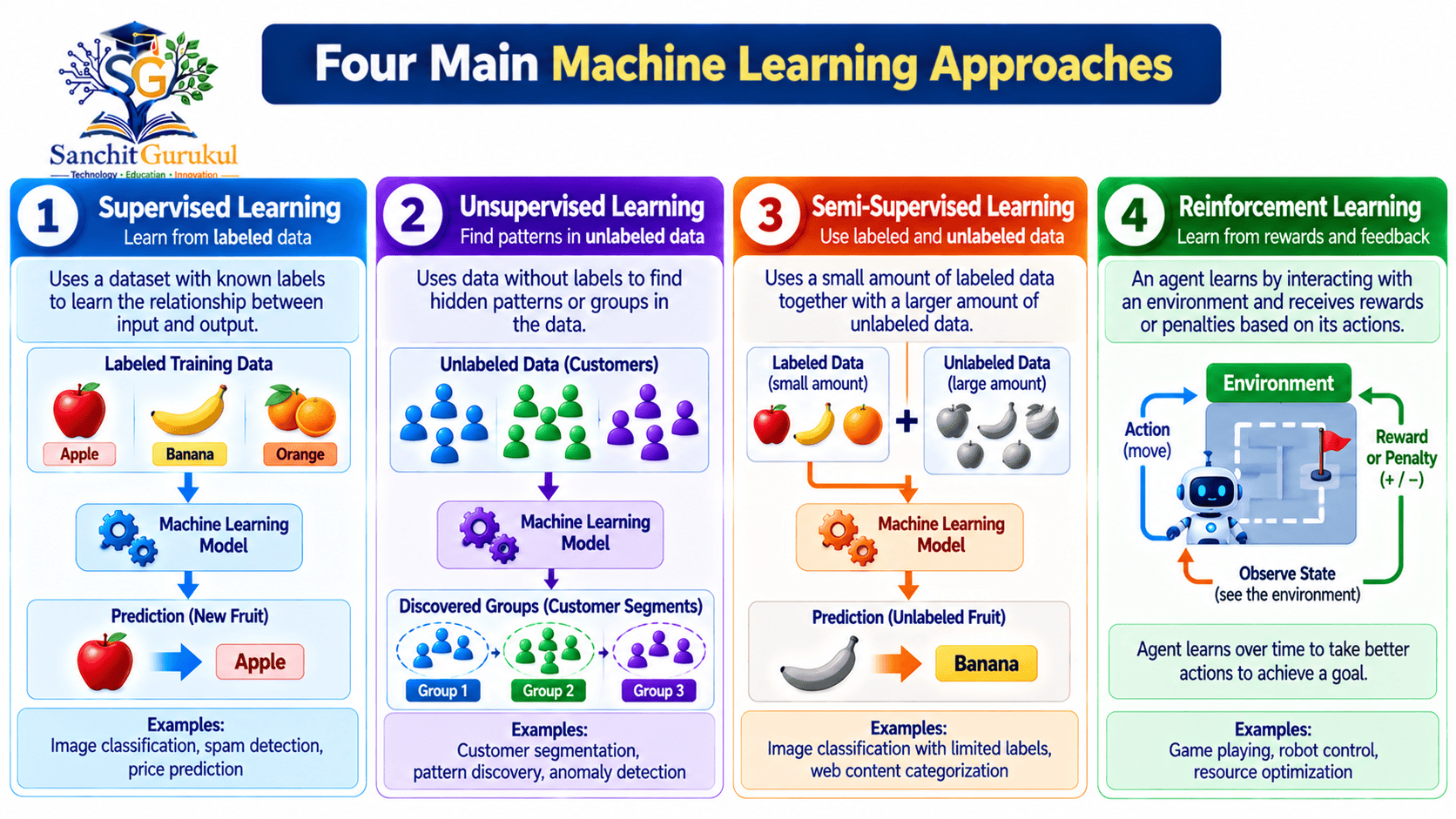
Machine learning includes several learning approaches.
They differ mainly in the information available during training and how the model receives feedback.
1. Supervised Learning
Supervised learning uses examples with known answers or labels.
The model learns relationships between the input information and the expected output.
For example, a training dataset may contain emails labeled:
- Spam
- Not Spam
The model learns patterns that help it classify new emails.
Two common supervised learning tasks are classification and regression.
Classification
Classification predicts a category.
Examples include:
- Spam or Not Spam
- Fraudulent or Not Fraudulent
- Cat or Dog
Regression
Regression predicts a numerical value.
Examples include:
- Estimated house price
- Expected electricity consumption
- Forecast sales revenue
2. Unsupervised Learning
Unsupervised learning looks for patterns or structure in data without the same predefined answer labels used in supervised learning.
One common technique is clustering.
Clustering groups records that have similar characteristics.
For example, an online store may group customers with similar purchasing behavior.
The groups can help analysts explore patterns.
However, the resulting groups are not automatically meaningful, correct or fair.
3. Semi-Supervised Learning
Semi-supervised learning combines a smaller amount of labeled data with additional unlabeled data.
For example, an organization may have:
- 500 images with verified labels
- 5,000 additional images without labels
A suitable semi-supervised method may use both sets during training.
This approach can be useful when accurate labels are expensive or difficult to obtain.
However, it is not automatically better than fully supervised learning.
4. Reinforcement Learning
Reinforcement learning involves an agent learning through interactions with an environment.
An agent is the system taking actions.
An environment is the setting in which those actions occur.
The agent receives feedback, often expressed as rewards or penalties, and attempts to improve its behavior toward a defined objective.
For example, a simulated robot may learn movements through repeated trials.
Reinforcement learning is different from training a model using a simple list of labeled answers.
Where Does Deep Learning Fit?
Deep learning is not a separate category at the same level as supervised, unsupervised and reinforcement learning.
It is an approach using multi-layer neural networks.
Deep learning models can be trained using different learning methods.
Types of Machine Learning Comparison
| Learning Type | Training Approach | Example |
|---|---|---|
| Supervised | Uses labeled examples | Spam classification |
| Unsupervised | Finds structure without predefined output labels | Customer grouping |
| Semi-Supervised | Combines labeled and unlabeled examples | Image classification with limited labels |
| Reinforcement | Learns through actions and feedback | Simulated robot control |
Important Machine Learning Concepts — Model, Accuracy, Overfitting and Underfitting
A few terms appear frequently in machine-learning discussions.
Understanding them makes technical explanations easier to follow.
What Is an Algorithm?
An algorithm is a defined set of computational steps used to solve a problem.
In machine learning, a training algorithm adjusts a model using data.
What Is a Model?
A model is a trained mathematical or computational system used to produce predictions or other results.
For example, an email classification model accepts information about an email and predicts whether it is spam.
What Is a Feature?
A feature is an input characteristic used by a model.
For a house-price prediction system, features might include:
- Floor area
- Number of rooms
- Location
- Building age
The model uses the available features to produce an estimate.
What Is a Label?
A label is the expected answer provided for a supervised training example.
For example:
An image of a cat may have the label cat.
What Is Overfitting?
Overfitting occurs when a model fits the training examples too closely and performs poorly on new data.
It may learn details that do not generalize to real situations.
For example, a model might learn irrelevant patterns in its training images rather than the characteristics needed to recognize an object reliably.
What Is Underfitting?
Underfitting occurs when a model fails to learn enough of the relevant patterns.
This can happen when the model or training process is not suitable for the problem.
For example, an overly simple model may be unable to capture important relationships in the data.
Overfitting vs Underfitting
| Concept | Meaning | Common Result |
|---|---|---|
| Overfitting | Learns training data too closely | Poor performance on new examples |
| Underfitting | Does not learn enough useful structure | Poor performance even on training examples |
| Good Generalization | Learns patterns that also work on suitable new data | Better performance beyond training data |
How Do We Measure Model Performance?
Different tasks require different measurements.
For classification, useful measurements include:
Accuracy
The proportion of predictions that are correct.
Precision
Of the items predicted as positive, how many were actually positive?
Recall
Of the actual positive items, how many were successfully identified?
For example, in fraud detection, accuracy alone may be misleading if fraudulent transactions are rare.
A system that classifies nearly every transaction as legitimate might appear accurate while missing many fraudulent transactions.
Therefore, model evaluation should consider the real problem and the consequences of mistakes.
Real-World Applications, Benefits and Limitations of Machine Learning
Machine learning supports many applications across different industries.
Its usefulness depends on data quality, model performance and how the results are applied.
Where Machine Learning Is Used
| Area | Example | Purpose |
|---|---|---|
| Spam classification | Identify unwanted messages | |
| Banking | Fraud detection | Flag suspicious transactions |
| Retail | Product recommendations | Suggest relevant products |
| Healthcare | Medical image analysis | Support professional assessment |
| Transportation | Demand prediction | Support planning |
| Agriculture | Crop monitoring | Identify useful patterns |
| Cybersecurity | Anomaly detection | Highlight unusual activity |
| Energy | Electricity demand forecasting | Support capacity planning |
| Entertainment | Content recommendations | Suggest movies or music |
Important Benefits
1. Identifying Patterns
Machine learning can find useful relationships in data.
2. Making Predictions
Models can estimate outcomes such as future demand or possible equipment failures.
3. Supporting Repetitive Work
Machine learning can help automate selected classification or analysis tasks.
4. Personalization
Applications can recommend content or products based on relevant information.
5. Supporting Decisions
Predictions can help people review options and investigate problems.
These are possible benefits, not guarantees.
Important Limitations
Data Quality
Incomplete, incorrect or unrepresentative data can lead to poor model performance.
Model Errors
Predictions may be incorrect, even when the model performs well on average.
Bias
Models may produce unfair outcomes if the data, design or deployment contains unsuitable biases.
Privacy
Training data can contain sensitive or personal information requiring proper protection.
Cost
Some machine-learning systems require significant computing resources, especially large deep-learning models.
Changing Conditions
A model may become less effective when real-world patterns change.
This is sometimes called data drift or concept drift, depending on what has changed.
Responsible Machine Learning Practices
For reliable machine-learning development:
- Define the problem clearly.
- Collect relevant and appropriately authorized data.
- Check data quality.
- Keep training and evaluation data properly separated.
- Select measurements suitable for the task.
- Review significant errors and possible bias.
- Protect sensitive information.
- Monitor performance after deployment.
- Use human review where the consequences of mistakes are significant.
A Simple Learning Activity
You do not need to install a machine-learning library to understand the basic learning process.
Imagine preparing a small dataset to predict whether a fruit is an apple or an orange.
| Example | Color | Shape | Label |
|---|---|---|---|
| 1 | Red | Round | Apple |
| 2 | Green | Round | Apple |
| 3 | Orange | Round | Orange |
| 4 | Orange | Oval | Orange |
The table illustrates labeled training examples.
A model could attempt to learn patterns from these features.
Now suppose you show it a new orange-colored fruit.
Can it identify the correct type?
Perhaps, but this tiny dataset is insufficient to establish reliable performance.
Color and shape can overlap between different fruits, and new examples may differ from the training examples.
The lesson is that a model must learn useful patterns and be tested on separate, representative data.
Key Takeaways
Core Concepts
- Machine learning is part of Artificial Intelligence.
- It allows models to learn useful patterns from data.
- Traditional programming and machine learning can work together.
- Deep learning is an approach within machine learning.
- More data does not always guarantee better results.
How Machine Learning Works
- Training data helps a model learn.
- Validation helps guide model development.
- Testing evaluates performance on separate examples.
- Features are input characteristics.
- Labels are expected outputs in supervised learning.
- Deployed models do not necessarily learn continuously.
Learning Approaches
- Supervised learning uses labeled examples.
- Unsupervised learning finds patterns without predefined output labels.
- Semi-supervised learning combines labeled and unlabeled data.
- Reinforcement learning uses actions and feedback.
- Classification predicts categories.
- Regression predicts numerical values.
Quality and Responsible Use
- Overfitting can reduce performance on new data.
- Underfitting means the model has not learned enough useful patterns.
- Accuracy alone may not describe model quality.
- Predictions can be wrong or biased.
- Privacy and security require attention.
- Important results need suitable validation and oversight.
Machine learning is one of the most important approaches used in modern Artificial Intelligence.
It allows computer systems to learn patterns from data and apply those patterns to new examples.
From email spam detection to banking security and product recommendations, machine learning is used in many everyday applications.
The main learning approaches include supervised, unsupervised, semi-supervised and reinforcement learning.
Understanding training, validation and testing is essential because a model must perform well beyond the examples used during development.
However, machine learning is not automatically accurate or unbiased.
Its results depend on the available data, training process, evaluation methods and operating environment.
For beginners, the best starting point is understanding how a model learns from examples and why its predictions must be tested.
Next in This Series: Supervised Learning Explained — Classification, Regression, Labeled Data and Beginner-Friendly Examples.
Useful Links and References
SanchitGurukul Static Resources
Official External References
Your feedback matters
Was this post helpful?
Discussion
0 approved comments
No approved comments yet. You can start the discussion below.
Leave a Comment
No login is required. Name and email are used for moderation/security. Your email is never displayed publicly. All comments require administrator approval.
Discover more from SanchitGurukul
Subscribe to get the latest posts sent to your email.

